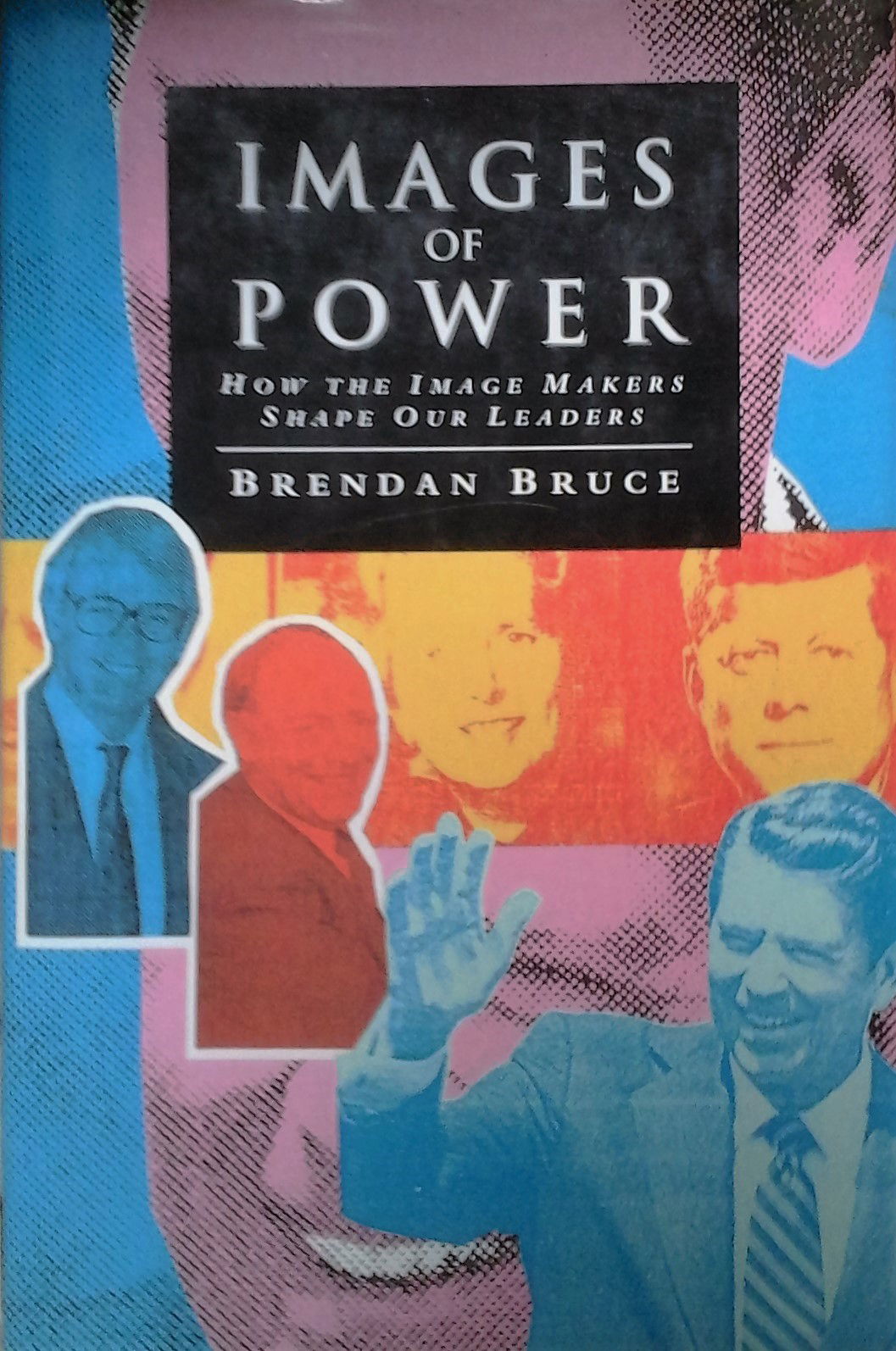
Images of Power
Most of the content posted on this site concerns the Dominic Lagan Gallery, but the gallery is part of a bigger institution, BrendanWorld. The latter holds archive material concerning Dominic Bruce, and some of my own personal content. Years ago, I deposited my diaries from my time as Mrs T’s spin doctor, plus some from my time advising African politicians, in the Bodleian. In 2008 I was contacted by the British Library who had read in the introduction to a book I wrote in 1992 that the book was partly based on a series of taped interviews with some senior experts. They took the original cassette tapes and made digital copies. They can be accessed at the Library, but not online. So, I thought I should make them publicly available on this site. Just go to the ‘Interviews’ tab.
First, a bit of background. In 1992 I signed a contract to write a book about political marketing in the UK and US. It was due for publication in time for the UK General Election in the following year. As part of my prep, I interviewed every Premier League expert I knew (which was everybody who mattered back then) with the sole exception of Sir Gordon Reece, who had tragically decided that he would neither be interviewed by others, or write a book himself. I knew most of them well, so the conversations were essentially off the record chats, rather than journalistic interviews. The interviewees were reasonably relaxed, frank and candid. The full list was Alastair Campbell Barry Delaney Sir Bernard Ingham* Sir Chris Lawson* George Jones Harvey Thomas* Howell James Ian Greer* John Hanvey* John Salmon* Lord Kenneth Baker Mary Spillane Michael Brunson Michael Shea* Michael White Michael Jones* Lord Chadlington (Peter Gummer) Phillipa Davies Robin Wight Stephen Sherbourne Stewart Purvis Lord Tim Bell* Sir Tom Arnold* Lord Tony Hall Winston Fletcher* *Now deceased
NB I also interviewed Charles Anson, the then Press Secretary to HM Queen Elizabeth II, in his Buckingham Palace office, but that was strictly on background and therefore (sadly) wasn’t taped. By agreement he was not named in the introduction to the book.
There were only two politicians Baker and Arnold, the latter because he was intimately involved in a major and top-secret project to use Reagan’s US pollster Dick Wirthlin to carry out research in the UK to produce an entirely new positioning for a Thatcher led party. This (very expensive) work was dumped by Chris Patten when Major appointed him Party Chairman, partly out of ignorance (he knew nothing about political marketing but was far too arrogant to admit it); and partly out of his desire to eradicate Thatcherism from the Conservative party, in a rerun of the post war ‘de-Nazification’ programme. Every Cabinet Minister was nevertheless given a detailed briefing by Tom on the research and the thinking behind a possible new election strategy for the party. I’ll never forget the meeting in late 1990 with William ‘So wet you could shoot snipe off him’ Waldegrave who watched in growing horror until he could stand it no longer. “But Chris” he said in agonised tones, “surely that’s Thatcherism!”
After a long discussion at a secret strategy meeting at Hever Castle in early 1991, the whole election strategy was dumped. Subsequently the media were mendaciously briefed that the previous Party leadership had failed to come up with any election strategy, and it was replaced with Major’s soap box. Tim Bell was fired and the Saatchi Bros brought back in.
Luckily, the UK wasn’t ready for an administration run by Kinnock, Hattersley and Mandelson. Patten himself lost his seat, which gave enormous pleasure to many, and he subsequently worked on his long running Pooh Bah tribute act.
Patten was unique in my experience as the politician whose public persona was least like the private reality. In public he was a classic liberal, easy going, literate, witty, friendly etc. In private he was a mean-spirited bully, especially to those who (unlike me) couldn’t answer back, someone who would not have survived the modern era of employment tribunals. His promises were worthless, and his vile temper was legendary amongst those in the know.
I’ll never forget watching him once late at night in a BBC corridor, red-faced and virtually speechless with rage, prodding a much larger and visibly apprehensive David Dimbleby in the chest for some long-unremembered attack on his monumental ego. I thought about intervening, but given Dimbleby was the most smug and self-satisfied person on the planet, I decided that if it got completely out of hand I would leave it to the Metropolitan Police to manage the ensuing crisis.
Patten was a huge learning experience for me. It taught me to ignore the surface, and look for the reality underneath public behaviour. He famously stabbed Thatcher in the back, and backed Hurd for PM. It was only when I started working with him that I realised why. He thought that if Hurd won, he would become the Crown Prince, and eventually take over from Hurd when he came a cropper (or when Fat Pang cut his throat).
I was very disappointed in myself that I was so taken in at our first meeting in 1989 at some think tank lunch. I recently looked up the diary entry for that day. Apparently, I was an instant fan. I just shows you how naif you can be faced with someone who really knows how to hide their real character, at least in public.
Luckily, a friendly spy told me in advance that, having acquired a taste for it, he planned to stab me in the back too. When he did, I was ready with a set of very expensive and very shark-like lawyers. His face when he saw all those 0000s on the six-figure buy-off cheque was priceless, and worth every penny of their Great White fees. However, in a perfect illustration of his petty-minded, mean-spirited and spiteful character, he eventually got his own back by banning me from the next annual Party conference!
Kenneth Baker was an obvious choice. We were close personally, and he was an exceptionally shrewd observer of everybody engaged in high politics. At the time of the interview, he was Home Secretary. He was witty, well-read, and highly cultured, and he was right at the heart of politics for all of the eighties and nineties. The book I’d really like to read would be his private diaries, as he could be amusingly acid about his more hopeless colleagues (the majority).
Four senior Lobby journalists (five if you count Ingham) i.e. George Jones (Daily Telegraph); Michael Brunson (ITN); Mike White (Guardian); Michael Jones (Sunday Times), plus two very senior media executives, Tony Hall (BBC) and Stewart Purvis (ITN). All of them firmly in the 10% (see below).
One press secretary, Bernard Ingham. People at the time thought he was just a somewhat old-fashioned print man, unable to adapt to the TV age, but I didn’t find him so. He was politically shrewd e.g. he was the only Whitehall pro to call the 1992 election result exactly right. A man of great integrity, he was loyal to a fault, despite his career beginnings as a devoted Labour supporter. Old Labour that is, before Philip Gould decided all that Clause 4, Socialism, Ragged-trousered Philanthropists, Beer & Sandwiches, singing the Red Flag, renationalisation & redistribution, to each according to ….etc etc was simply a barrier to power, and that they should dump all that old fashioned nonsense into the dustbin of history, and campaign on a ‘well, at least we aren’t Tories’ strategy, which was very successful in 1997, 2001, 2005 and 2024, but inevitably went wrong when the Tories finally got their act together in 2010, having appointed my old colleague ‘Dave’ Cameron.
Bernard was replaced by Gus O'Donnell (not only an Old Salesian, but also a Warwick graduate, just like me) who told me that he didn’t ‘do image’, an attitude which greatly added to John Major’s dégringolade.
Major mostly brought this on himself as he rejected the advice of anyone that had worked for Thatcher (as part of the ongoing ‘de-Nazification' programme), until he got into terminal trouble, and it was only then did he in a sweaty funk ask for advice from the real experts. He then rejected the good advice he did eventually get, mainly I think because he had deluded himself into thinking that he alone was responsible for winning in 1992.
If those ex Thatcher team members who did (reluctantly) try to steer him in the right direction had known what was in Judith Chaplin’s very frank and revealing diaries (which surfaced briefly, but now seem to have sunk into obscurity awaiting the Major post mortem biography) they would have refused to have anything to do with him.
Five Mad Men: Barry Delaney (Labour); Sir John Hegarty (maybe a bit gauche caviare, but essentially non-political); John Salmon (Tory); Robin Wight (nominally a Tory, but in fact leader of The Robin Wight Party); and Winston Fletcher, who master minded the early days of the SDP’s marketing, which is where I came into view for the first time as a professional strategist.
I was working for Winston at the time, and he asked me to act as his ADC, as he knew both that I had studied politics at Warwick, and that I was still very interested in the subject. What he didn’t know was that I was desperate to work on the SDP’s marketing, as I had recklessly boasted to my politics tutor that I was going to write the standard work on political marketing by the time was forty, and I needed the cred. When I finished the final draft of ‘Images of Power’ in January 1992, I made good on my boast, but only by the skin of my capped teeth.
Obviously, I ‘forgot’ to mention that SDP experience in my interview with Mrs T. She despised them.
Fletcher was one of the most fascinating minds in advertising. This sounds like a joke in the context of today’s boring, mediocre and institutionally woke advertising industry, but back then there were many first-class thinkers like him in a business which was a significant cultural force.
John Hegarty, another deep thinker, was very interesting on the subject of the Royal Family, and how far they should go in letting in daylight upon the magic, especially relevant to the situation they find themselves in today, when the media’s residual deference (which was really just admiration for the late Queen, rather than the institution) has practically disappeared.
Michael Shea was also fascinating about how he had tried to let more daylight in, so much so that I had to redact some of his comments as simply too candid.
With a project like this, one of your main objectives is not to receive a visit from (in ascending order of terror) libel lawyers, the Old Bill, Box 500, the ‘Ndrangheta, or worst of all, Buck House.
I was privileged to work closely with John Salmon. I never used his nickname, Smokey, as I was too much in awe. It was said that he was one of the three best copywriters of all time, and I believed it.
Robin Wight looked demented, but was in fact as cunning as a fox with a double starred first in cunning. He was also incredibly energetic, resilient, determined, and a very good writer.
I was never so smug as when in 1987 I beat him in a gigantic pitch (perhaps £70 million in today’s money) for the DTI’s campaign to make UK business aware of Mrs T’s pet EU project, the upcoming Single European Market. The account had been promised to Robin by his mate David Young (aka Lord Young of Graffham) the then Secretary of State. But the civil servants insisted on a competitive pitch, five agencies, one hour each. No problem thought Wight, David will hear all five pitches patiently, smile , and then just give it to me.
While Robin was dreaming about where to moor his second yacht, I spent £100,00 of New York’s money on making a TV ad (about £365, 000 in today’s moolah) and wrote an ego-mad solo seven-minute pitch, about 53 minutes shorter than the loquacious (I’m being polite) Wight. When I had finished my seven-minute pitch, and pressed play on the Betamax, Young looked at his deputy Francis Maude. And Francis looked at David. I looked at them both and knew with a weird level of certainty I had just won the biggest contract of my life.
OK, that's enough from ‘Aren’t I just great’, chapter 97 of my magnum opus, ‘How I came to rule the World’.
One marketing expert, Chris Lawson. Historians are going to be a lot more interested in this interview than perhaps any other. As far as I’m aware, this is the only interview he ever gave, and he never wrote anything about his days advising the Conservatives on political marketing. He’s a largely forgotten figure now, but that’s a mistake, as he was the first top-level marketing expert to work in British politics. If you are a PhD student looking for a thesis, Lawson’s role would make a good one. And you never know, people in politics might actually read it.
One top level event organiser, Harvey Thomas, who had started his career in America, notably with Billy Graham, and so brought a lot of US techniques to the UK, which resulted in the previously staid Tories appearing much more dynamic, professional and competent. This was very important back then because the Labour offer was ‘we care’, but people were worried that they were not competent to run a government. The same people thought the Tories ‘didn’t care’ but were reasonably happy to ignore that, but only if they could demonstrate competence, especially on running the economy.
One clothes and grooming expert, Mary Spillane, who I chose because she had a great deal of political experience. It was pretty typical back then for the men in the UK political establishment to ignore her (very rare) experience with gubernatorial, cabinet level, and White House politics, and only be comfortable with her in a role as an expert on ‘women’s matters’ like clothes. A serious and thoughtful person, she gave me some good insights into the importance of personal presentation.
One voice coach, Philippa Davies, who expertly explained the problems of posture and breathing on speech.
Two private office or ‘back room’ people, Stephen Sherbourne and Howell James, both ex SPADs. It was a truth universally acknowledged that Stephen was the safest pair of hands in Westminster, while Howell had extensive experience of commercial PR. I admired and respected both men very much, and was keen to get their uncensored views. Both homosexual (pronounced btw 'hommo' not 'hoemoe', as it's Greek not Latin), they were part of a gay subculture in the Tory party, which at the time of the interviews dare not speak its name. Both Stephen and Howell would have made first class cabinet members, but I think had decided that realistically that this was only available to the straight white male. Post Cummings, SPAD’s are a much commented on now, but back then their names and true importance was only known to the chosen few. At the time of these interviews (1991) both were right at the top of their game, especially as crisis managers. Their stock in trade was charm, calm under pressure, and excellent judgement: priceless virtues in politics, and rarer than you would suppose.
Two PR experts, Bell, and Gummer (now Chadlington, just). Tim needs no introduction, as he is easily the most important spin doctor of the 1980s and 90s, with superb networks in government, media (especially Murdoch) and big business. Ironically, his only PR failure was being out manoeuvred by Charlie ‘It was only a playful tiff Your Honour’ Saatchi, who convinced the media that it was he and not Bell or Reece (or the British electorate) who elected Thatcher, when in fact his knowledge of political marketing could be written on the back of a Penny Black, with room for the Lord’s Prayer.
The "Labour isn't working" advert (predictably a fake, the queue was photoshopped) designed by Saatchi and Saatchi was seen by some in the dim end of the press as playing a key role in the Conservative general election victory of 1979. To this day it is represented as a triumph for Chas and Mo Saatchi, but in fact it was created by Jeremy Sinclair (who also created the Tony Blair ‘demon eyes) https://en.wikipedia.org/wiki/Jeremy_Sinclair and art director Martyn Walsh. Chas at first didn’t like it. He quickly changed his mind when his PR people managed to convince gullible reporters that he was a genius. Mo got a peerage, whilst the real hero Jeremy got a consolation CBE and then was quickly airbrushed out of history.
Bell was clever, driven and ambitious, but he had a reckless side to him concerning money, drugs, and women. He was a truly brilliant strategist, and was much closer to the instincts of the average voter than most spin doctors, who normally encounter them solely in their role as drivers, waiters, charladies, First Class cabin crew and personal shoppers. People constantly underestimated him, especially as he hadn’t attended university, and was seen as something of a flash ‘wide boy’. But Mrs T trusted him completely, and was extremely fond of him personally (she always called him ‘dear’).
I realised it was all up with her when in the summer of 1990 I encouraged Tim (and Gordon Reece) to go to Sunday lunch at Chequers and persuade her to abolish (or at least ameliorate) the Poll Tax. This was vital because all those backbenchers who had been elected in 1987 for marginal constituencies were terrified that without its abolition they would have to go back to their incredibly dull jobs as HR managers in provincial widget factories; and were being harassed by their wives (who understandably loved all those engraved invitations from people who wouldn’t normally have given them the time of day) to get rid of her. They were frightened, and thought that with her they would lose, but with just about anybody else e.g. Tarzan, they might just keep their nose in the trough and the stiffies on the mantelpiece. For the first time since 1975 she simply refused point blank to listen.
My view was that if Tim couldn’t make her see sense, then nobody could, not even Denis.* That was the beginning of the end. Despite all the self-important media pundits at the posh end of Fleet Street tendentiously insisting that the cause of her downfall was ‘Europe’, it actually was those wives that were Thatcher’s real nemesis. In the leadership election, their husbands all lied to Thatcher’s campaign manager Peter Morrison, who complacently assured me ‘Brendan old boy, it’s in the bag’. In the 1992 election the Tories lost 40 marginal seats, every one held by a hen-pecked former HR manager in a widget factory. I exaggerate, but not by much.
One researcher, John Hanvey. A thoughtful, very experienced research expert.
One lobbyist, Ian Greer, another not very closeted gay, who was in his fifties by then, so had experienced the era when batting for the opposing team was very illegal, unless you were a rich and well connected MP like Chips, in the West End theatre like Binkie, or a member of the Royal Family like the Duke of X. The interview took place before the ‘cash for questions’ scandal, when Greer was easily the most important lobbyist in London. Some years later I had dinner with a much-chastened Greer in South Africa after the storm broke. He asked my advice about clearing his name. I strongly advised him not to go to court, but his sense of honour (his parents were Salvation Army officers, and he was a deeply devout and active Christian) meant that he couldn’t stand the shame and humiliation of the accusations. He felt his honour to have been besmirched, and his good name dragged into the gutter. He could have sold his company to Tim Bell for a small fortune and retired to somewhere tranquil, but he chose to engage with the justice system and predictably was quickly bankrupted and abruptly exiled.
In my view, there are only three good reasons to be in court. One, you wish to witness the downfall of your worst enemy from the public gallery. Two, you have been issued with a subpoena, and you have no choice but to comply. Three, you have been charged with a crime, and you have been forced to stand in the box and listen to people telling the truth about you (something I wouldn’t wish on my worst enemy).
You may have noticed that Mandelson’s name is absent. After initially agreeing to be interviewed, he subsequently sent a letter pulling out. I think he feared a trap, wherein he made some sort of disastrous gaffe that would become news during the election campaign in which he was standing for the first time, hilariously for poor, grey, old, downtrodden, very uncool Hartlepool.
If only he had accepted, the world might have learned before it was too late that he was a narcissistic sociopath; and, given how pathetically easily Epstein manipulated him, a greedy man who lacked integrity. Con men like Epstein know that you can't cheat an honest man.
In the event, he probably would have sold me a large pack of self-aggrandising pork pies. Overall, my advice to budding spin meisters is to avoid people like him (and George Osborne, two sides of the same coin, except Mandelson is a nicer person) who see politics as merely a game to be played out on private islands, six star hotels, East Side mansions, and the blingy yachts of louche Russian oligarchs.
The real problem with Mandelson was and is that (like Aesop’s scorpion), you can’t trust him to tell the truth, assuming he knows what that is any more. So interviewing journalists who knew him well turned out to be a much better option.
I’d certainly recommend listening to George Jones (part 1) who is is very interesting on Mandelson’s approach which mixed deviousness, gossip, conspiracies, threats and blackmail. And he had a real genius for smearing and undermining his enemies i.e. people in the Labour Party who obstructed his (self-deluded) progress towards Number Ten.
Mandelson didn’t create the red rose as Labour’s new brand identity like you read in all the history books, because it was already the standard logo for European parties of the Left.
He didn’t create New Labour either, that was Philip Gould, who died prematurely, which was convenient as it meant he was unavailable to contradict Mandelson every time he claimed authorship (or at least didn’t deny it).
But he did have one major achievement i.e. the creation of what I used to call Mandelson’s Monstrous Regiment of Useful Idiots. A body of (mostly) men who printed pretty much anything he fed them, usually without troubling themselves to verify it. Some did it because they were threatened, or blackmailed. Some because they want to scratch some part of Mandelson’s anatomy, in the hope of favours to come. Some because they just loved spiteful gossip. Most because they were terrified of their editor saying (yet again) ‘why the fuck haven’t we got that story?!’
It still goes on to this day. Petie was offered half an hour of BBC prime time recently to tell everybody just how innocent he was of all charges, and answer a few (to him at least) softball questions, which he easily evaded or deflected, without (as he did to the FT when they confronted him with the results of Project Jeep), imitating Logan Roy and telling anyone to fuck off.
The ‘interview’ took place on January 11th. The police were so impressed with his stout defence under this pitiless interrogation by Laura ‘Anything Emily Maitlis can do, I can do better’ Kuenssberg, they waited all the way to the following February 23rd to arrest him.
There the discussion ends. The British media long ago imitated the French and gave up on the whole ‘innocent until proven guilty’ thing, but I have a lingering fondness for it.
If anyone is surprised to see Campbell on the interview list, they shouldn’t be. Yes, the plastic Scot act is a bit tiresome, but then sometimes I’m a plastic Irishman, so who am I to talk. He’s a Burnley supporter so he’s known a lot of grief in his life. As have I, being a Spurs supporter for the last sixty years.
The fact is that I trusted him. He was straight. He was honest, in a brutal sort of way. If he made you a promise, he kept it. He never lied to me, at least I never caught him in the process of lying to me. And ever since my parents used to take me to the Edinburgh Tattoo, I’ve a penchant for the bagpipes and soft porn.
So, I tried to be helpful, to the utter bewilderment of colleagues.
But by then I had developed my famous ‘10/20/70’ theory of the Lobby.
It’s not actually famous, but it should be.
It goes like this.
10% are intelligent, hardworking, relentlessly curious professionals with wide networks of sources at the top levels of government. They are good writers, and care about ethics in an ‘up to a point Lord Copper’ kind of way. They want to get the story right, which means being careful to stand it up properly. They study their subject carefully, and read dull policy papers and pie charts.
Their only problem is that they are the political equivalent of the man in the stand at White Hart Lane, they are essentially spectators. They have never actually done the job I did, or stood for office. For example, they knew all about the secret WHAM meetings on Monday mornings in the Cabinet Room, but they couldn’t attend, and everyone was very careful not to leak the discussions. Except me of course.
My relationship with Mrs T (basically, I was viewed by Her as Under Milk Wood’s Nogood Boyo come to life) was once strained to the absolute limit when I briefed George Jones based on a discussion in WHAM. The fact that my intentions were good (I was defending SWMBO) was no defence. The rule was inviolable: what went on in WHAM (‘week ahead meeting’) stayed firmly in WHAM. Nobody had ever leaked. Not even Chaz Pole. In a rage she threatened to fire me on the spot, but was taken aback when I replied (through Kenneth Baker, who was, not for the first or last time, caught in the middle) ‘Go ahead’. She backed down. Bad idea. Emboldened I leaked the hilarious but outrageous ‘Scarlet Pimpernel’ joke she told in the WHAM just before attending the French bicentennial of their soi disant ‘Revolution’ (i.e. the attempt of bourgeois lawyers to make more money at the expense of the aristos, whilst simultaneously try and failing to manage a mob of violent psychopaths). If anyone had printed it (they were all too scared) it would have caused a bigger noise than the September Massacres.
But the outstanding characteristic of the 10% is that they can be trusted. If they say they are going to do something, they do it. More importantly, if they promise they will not do something, they don’t, even if the editor gets menacing.
What of the 20%? These are St Tony’s real feral pack of cackling hyenas. Drunks, coke heads, thieves, adulterers, you could find them any time propping up the saloon bar in the ‘Three Liars’, or in the maisons closes of Mandeville Place. A dying breed nowadays, mostly still employed by the red tops, they (virtually all men) would do literally anything. Their favourite was to hammer on the doors of grieving parents until the enraged and tear-stained father emerged, and their snapper colleague got his shot. As that was happening, another colleague entered the house by the back door and swiftly removed the family photos (including the murdered schoolgirl in her uniform) from the mantel piece in the parlour.
They would doorstep anyone except Her Maj, as that would bring a visit from very large men in size 16 boots. They would hack phones, ferret through dustbins, harass small children on their way to school and widows by the graveside. As the former news hound turned Hollywood scriptwriter Ben Hecht put it: “I'll tell you briefly what I think of newspapermen. The hand of God, reaching down into the mire, couldn't elevate one of them to the depths of degradation”. Eventually they would do something even Kelvin couldn’t stomach (and that’s the gold standard of wickedness) and be demoted to provincial rags, or exiled to the lower reaches of PR, before being found dead in the odiferous outside lavatory of some nicotined off-Fleet Street hostelry, holding a betting slip in one hand, and a tart’s phone number scrawled on a pack of fags in the other.
So that just leaves the 70%. Like in every human institution these are the average. The mediocre. The dull. The lazy, careless and inaccurate. The ‘copy and paste’ from Wikipedia. They go on X, find a couple of quotes from deranged loners in basements, which will ‘stand the story up nicely’. They are dreadful writers. Tropes and memes are their go to content. They never have an original idea, but they are expert thieves of others. They are the masters of click bait, and understand the vital importance of metrics in impressing those editors to whom the digital revolution is still a complete and utter mystery. They never have good sources, and the ones they do have lie to them all the time.
They work to pay the mortgage and the child maintenance they (if male) incurred when they unwisely swapped the loyal but somewhat faded first wife for the younger model with the suspiciously perfect chest. Or (if female) to pay their ‘Dial-a-Coke’ dealer in Stokie.
They never deviate from the party line, not even at the Guradain, the UK's answer to ‘Pravda’, when it censors and then fires their posh female columnists for writing outrageous TERF lies like ‘Trans women are not women’.
They are very scared that their bosses will one day read an article about imposter syndrome and put two and two together.
But their outstanding characteristic is the fact they are completely untrustworthy. Avoid at all costs.
There it is, “Brendan’s Grand Theory of the Modern Media”, coming out soon in a BookTok post.
btw 'Images of Power' did reasonably well, selling out its print run, and I still get ALCS royalties to this day. And there was even a paperback version in Chinese, published by the Rev Moon. The rumour was that Deng Xiaoping had it on his bedside table when he died, but I think it may have been me who started that rumour.
As Logan wouldn’t say, tootle pip!
Brendan
* Denis Thatcher was instrumental in me being appointed Director of Communications in 1989. Mrs T objected to me being paid the same as a Cabinet Minister (even though I had already agreed to a huge cut in salary from what I was getting at DMB&B). Apparently, there was a rustle of the evening paper from the sofa. "Yes Denis?" enquired the PM. "Pay peanuts Margaret, get monkeys!" said the oracle. End of all resistance, and the job was mine.
Copyright Brendan Bruce 2026