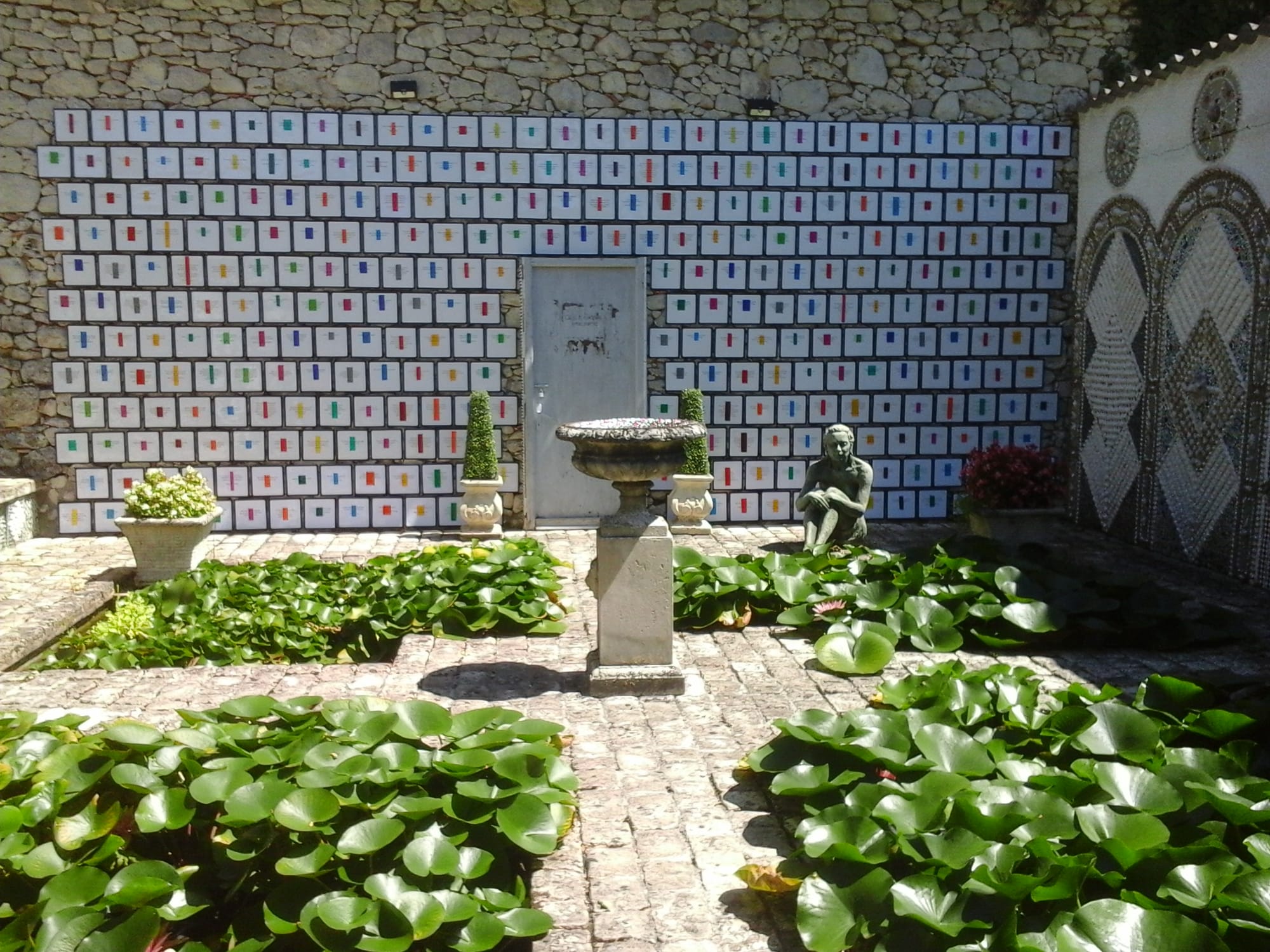
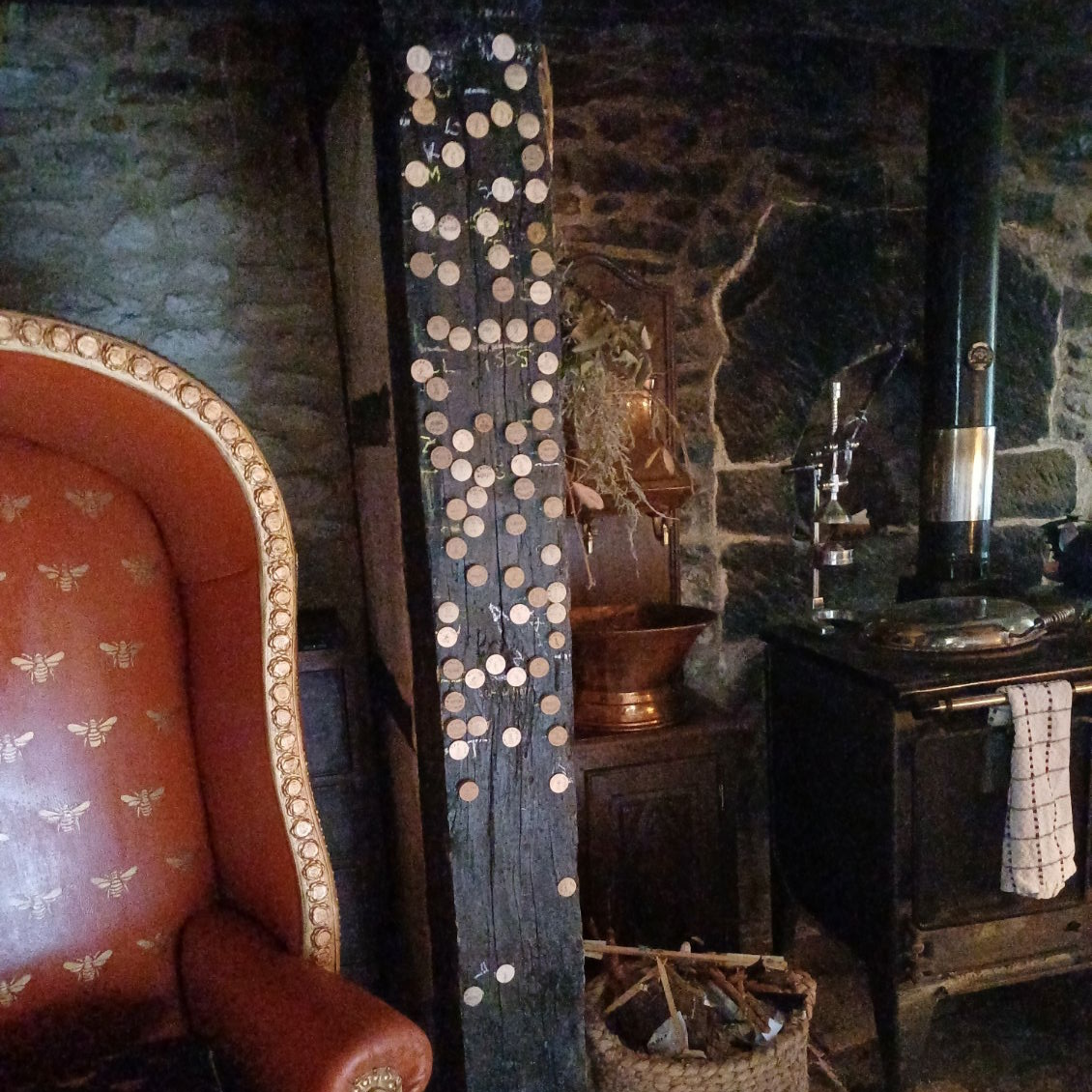
This installation was inspired by being given the gift of J.R.M. Keatley's privately printed limited edition 'commonplace' book. Keatley, an old and dear friend of Bruce, was the former Chairman of the Lansdowne Club, where Bruce lived for 45 years when he was in London. Bruce conceived the notion of making his own commonplace project, in the form of a wall, consisting of 350 tiles, each with a favourite quotation. House guests and other visitors were encouraged to be photographed pointing to their own favourite quote, as a souvenir of their visit. Eventually, the project came full circle when the wall was published as a book. It is a 'living' installation ie the wall is changed regularly, introducing new quotations.
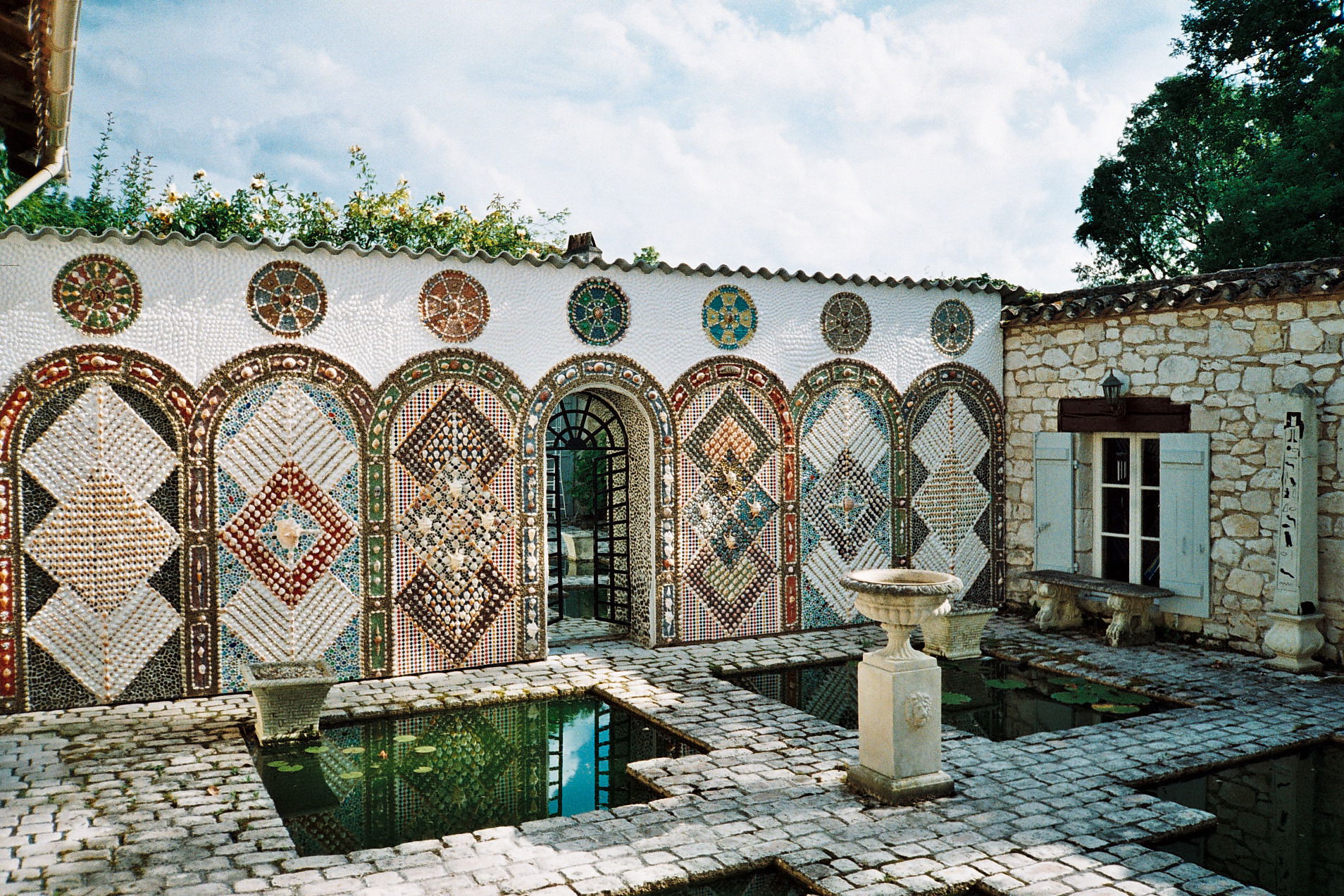
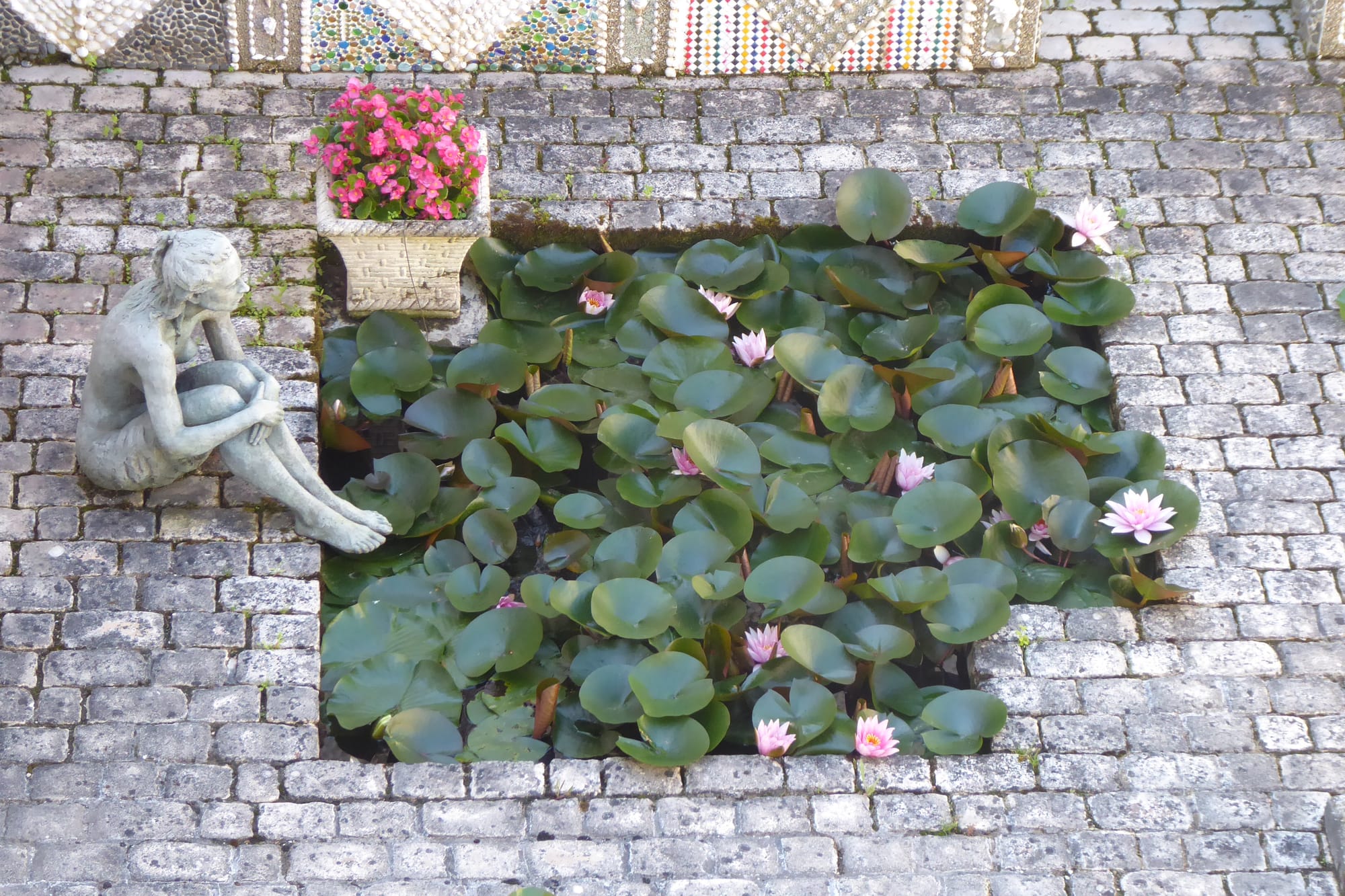
https://www.amazon.co.uk/OPENING-KEATLEYS-COMMONPLACE-BOOK-Aphorisms/dp/B0848R4Y38/ref=sr_1_10?crid=ZQWW6ORH2SU8&dib=eyJ2IjoiMSJ9.TU2AGvmqBBVZmpyYKM5fLVOnIPPcJDONahFFs6G90u4EKeNTDC6nN6Dn3aHfRrBhyx5r9kxlK9Gn91qThEWSoS3y0utbNJjU7o9FAlOjl7dFgcqlyU9DrZgf16yinqAsj-y9mIXZyBL1rLaWNo3_G247mTyA9NwLtS5HxFyx36Vw-CJeUxr8_uV6O_akIUhyK2xUBpy89JIqNfNzxdq3wffwNKwFjR2G2ehngW7OBd0.jwXdIw-VB1duwcHtC-EiYVCNbkQKbURfwWUQt0s49JU&dib_tag=se&keywords=brendan+bruce&qid=1772830214&sprefix=brendan+bruce%2Caps%2C275&sr=8-10An eight metre wall designed and built by Brendan Bruce, as part of the water garden which leads off the Salon Gallery via the French windows. The positioning angle of the central mirror is such that when exiting the Salon, you appear to see a further courtyard through the archway. This is both a nod to Bruce's favourite art of trompe l'oeil, and a philosophic observation. The other six panels represent the three heavens and the three hells of Buddhism, the seventh state of nirvana, where the mind is fully at peace (an illusion according to Bruce, hence the mirror). Mounted on OSB panels, the work consists of shells, mosaic tesserae, pebbles, compacted gravel, bones, coloured sand, and glass beads. The shells were imported (unassorted) from the Philippines in large crates. The seven panels are surmounted by seven Tibetan-style mandalas. It was inspired by a shell grotto at Boscombe, seen by Bruce as a child on holiday by the sea. It was also inspired by the previous owner of the Gallery, Jean Niolle, who was a cultivated scholar and collector of shells.
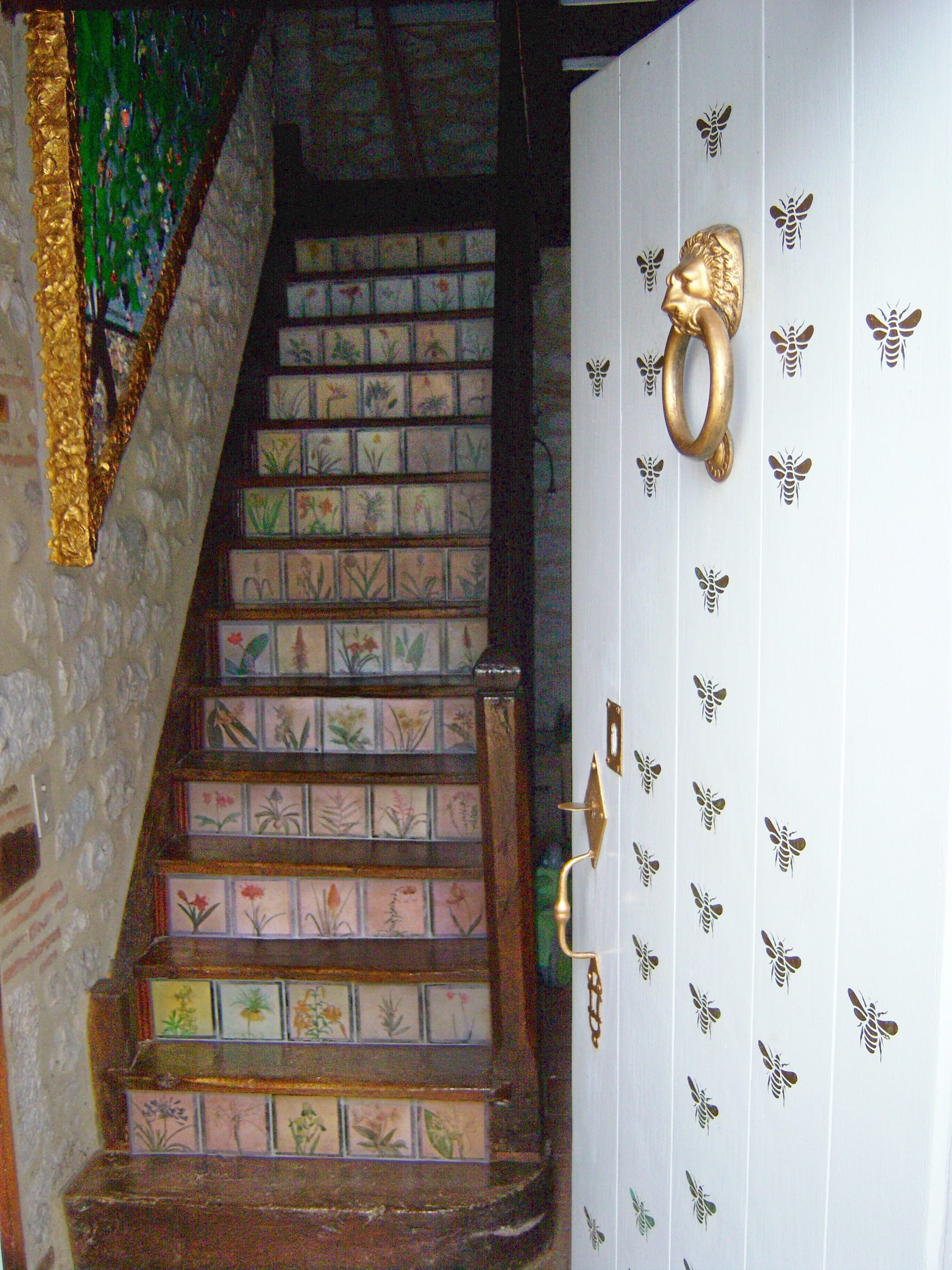
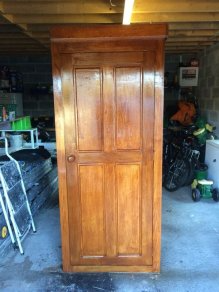
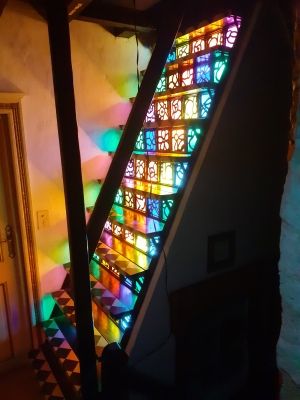
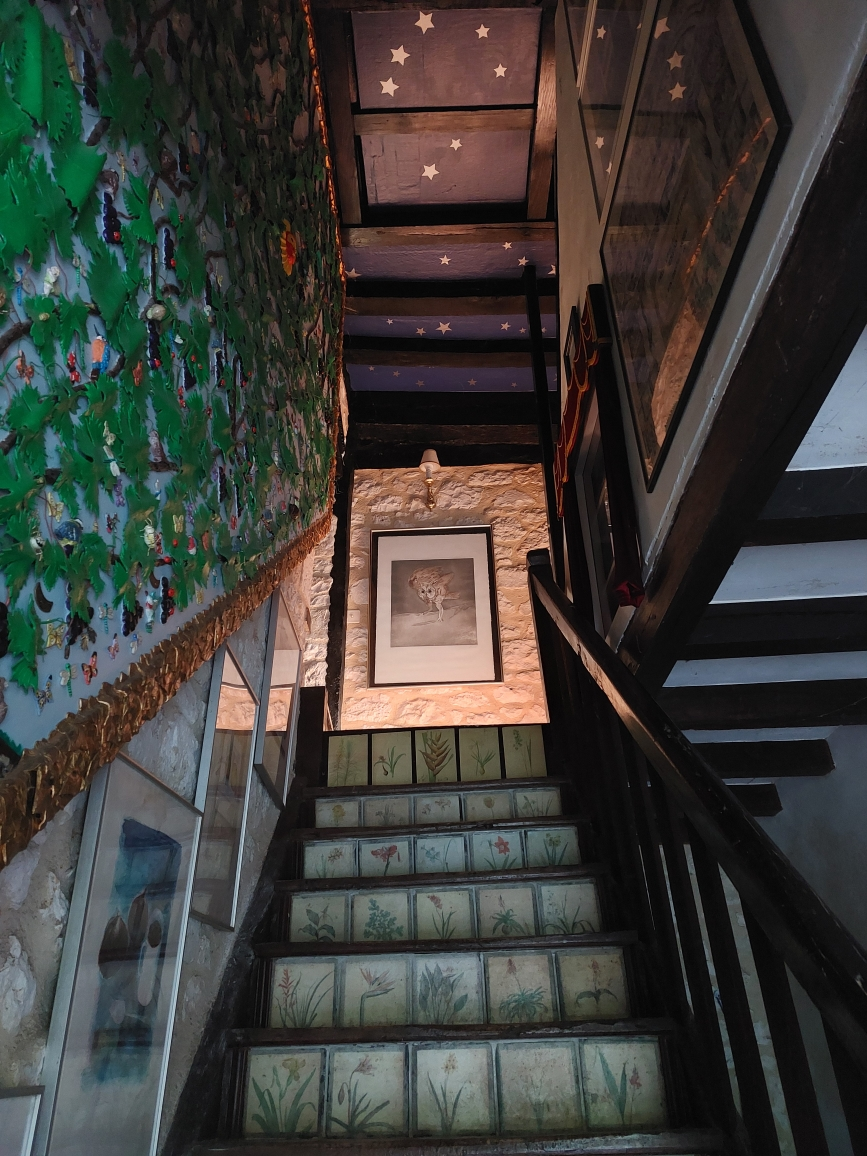
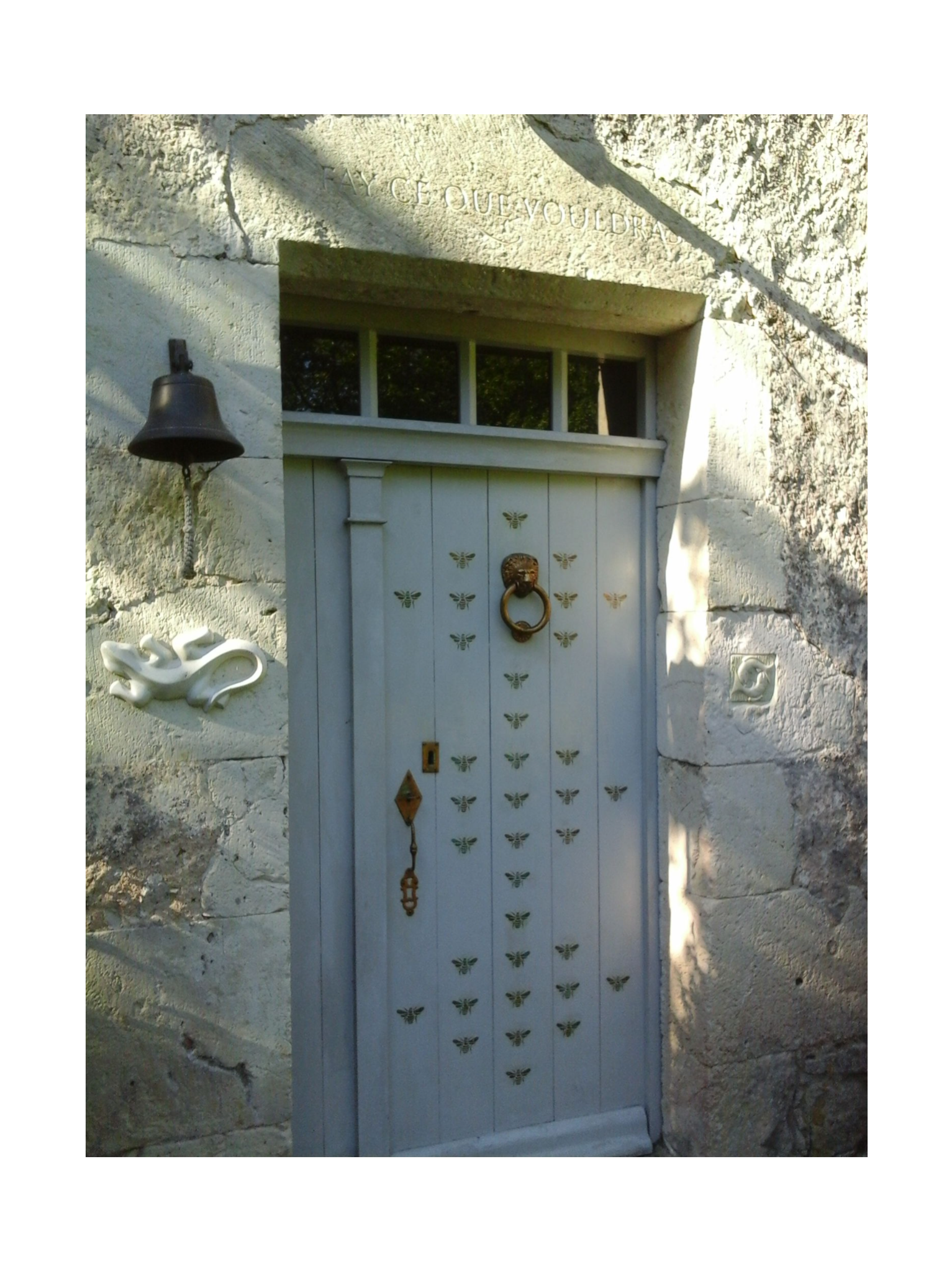
Manufactured tiles (using chemical transfer of ink jet copies) from Redouté's flower books at the University of Strasbourg were placed on the risers of an eighteenth-century wooden staircase. Painted and stencilled wooden door with original eighteenth-century door furniture, except the knocker, which came from the Palazzo Visconti, Milano
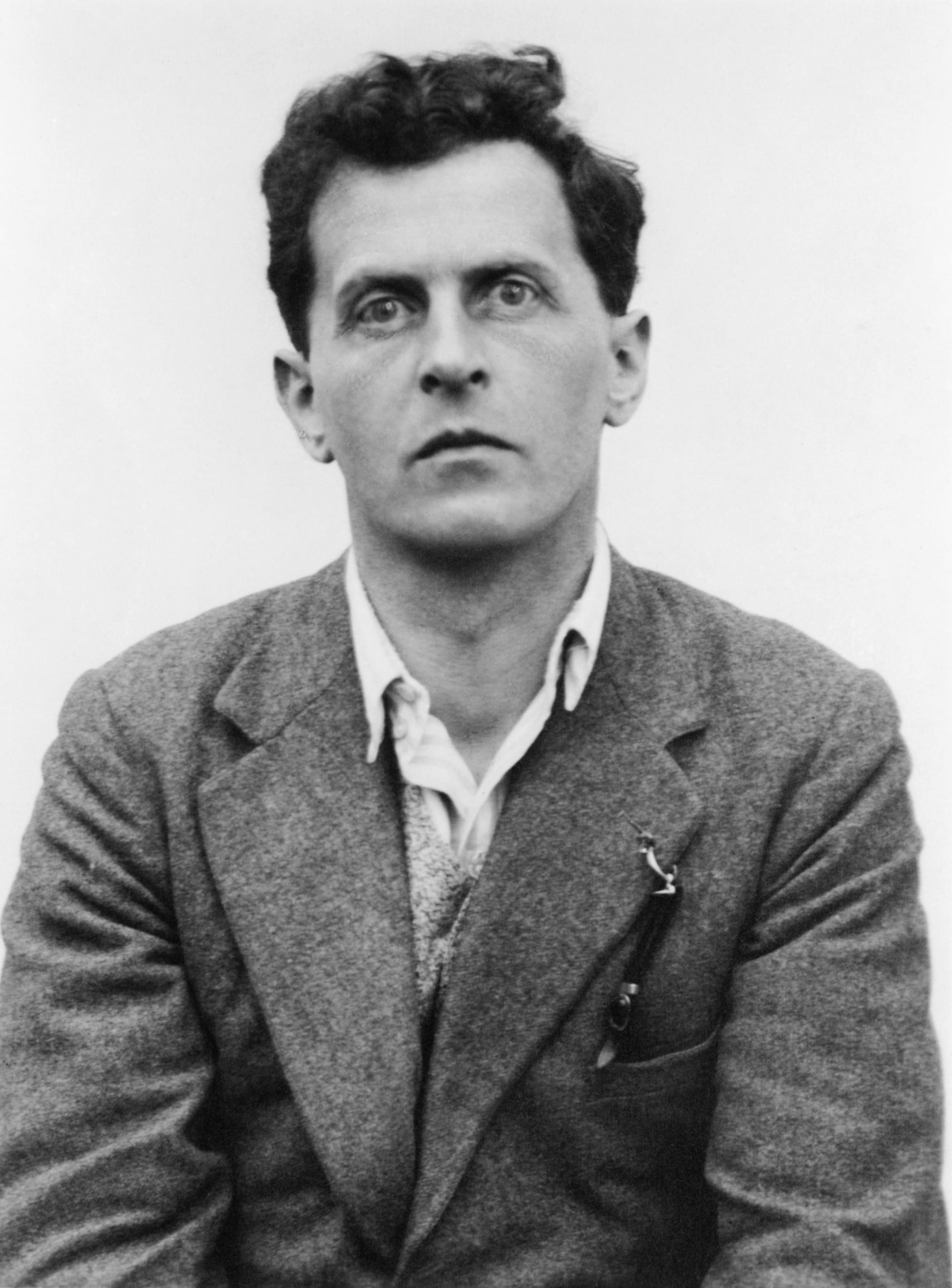
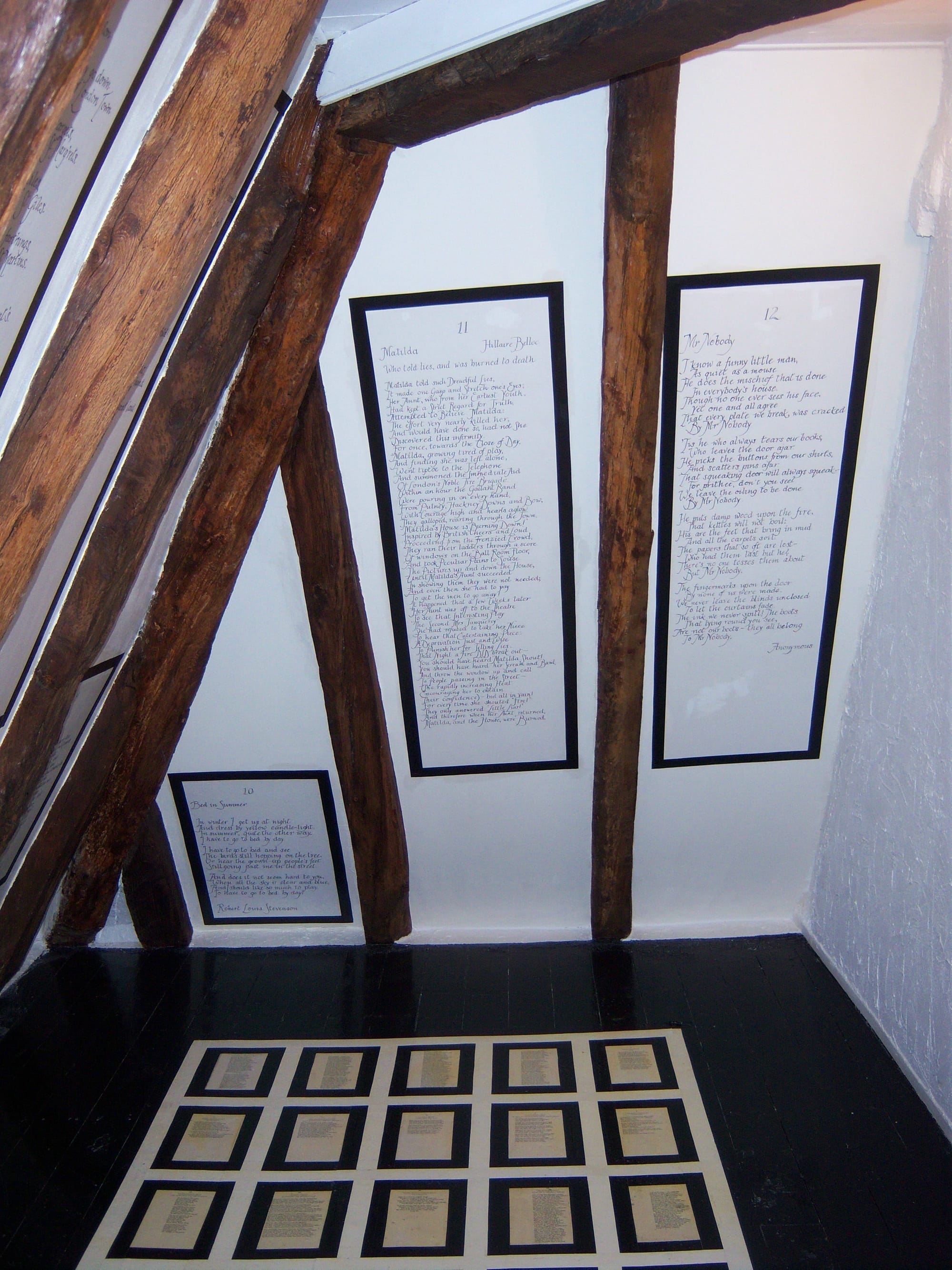
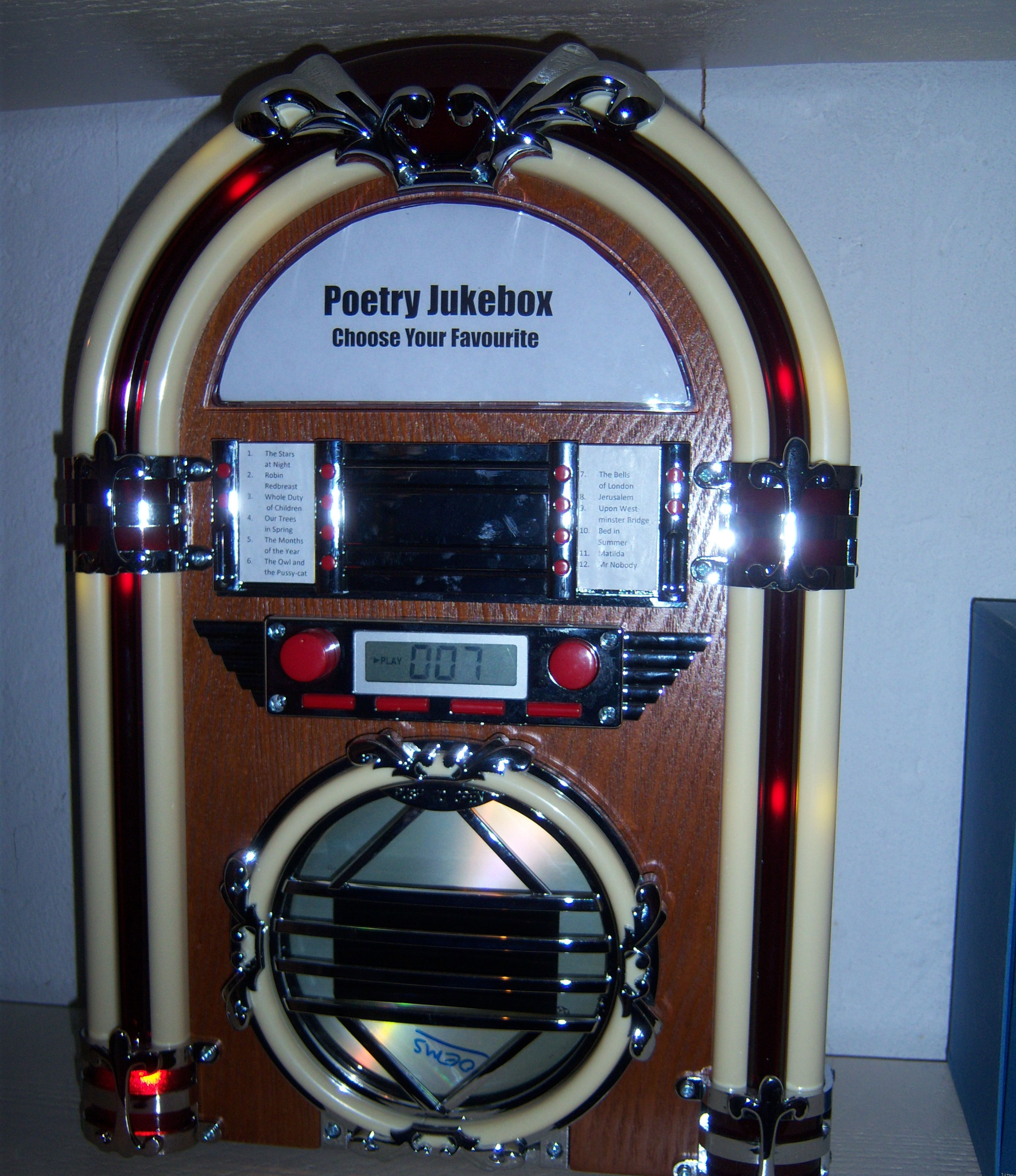
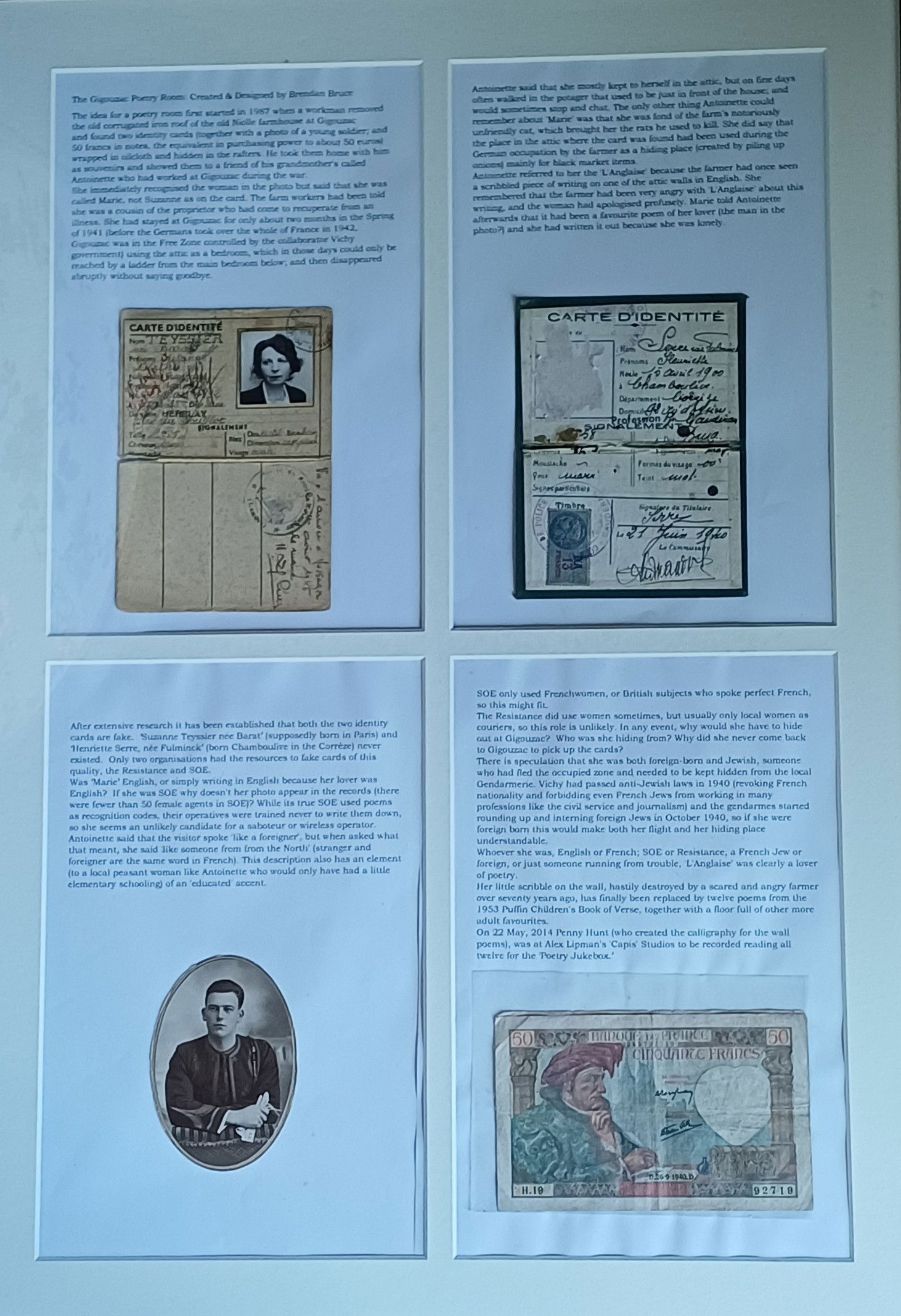
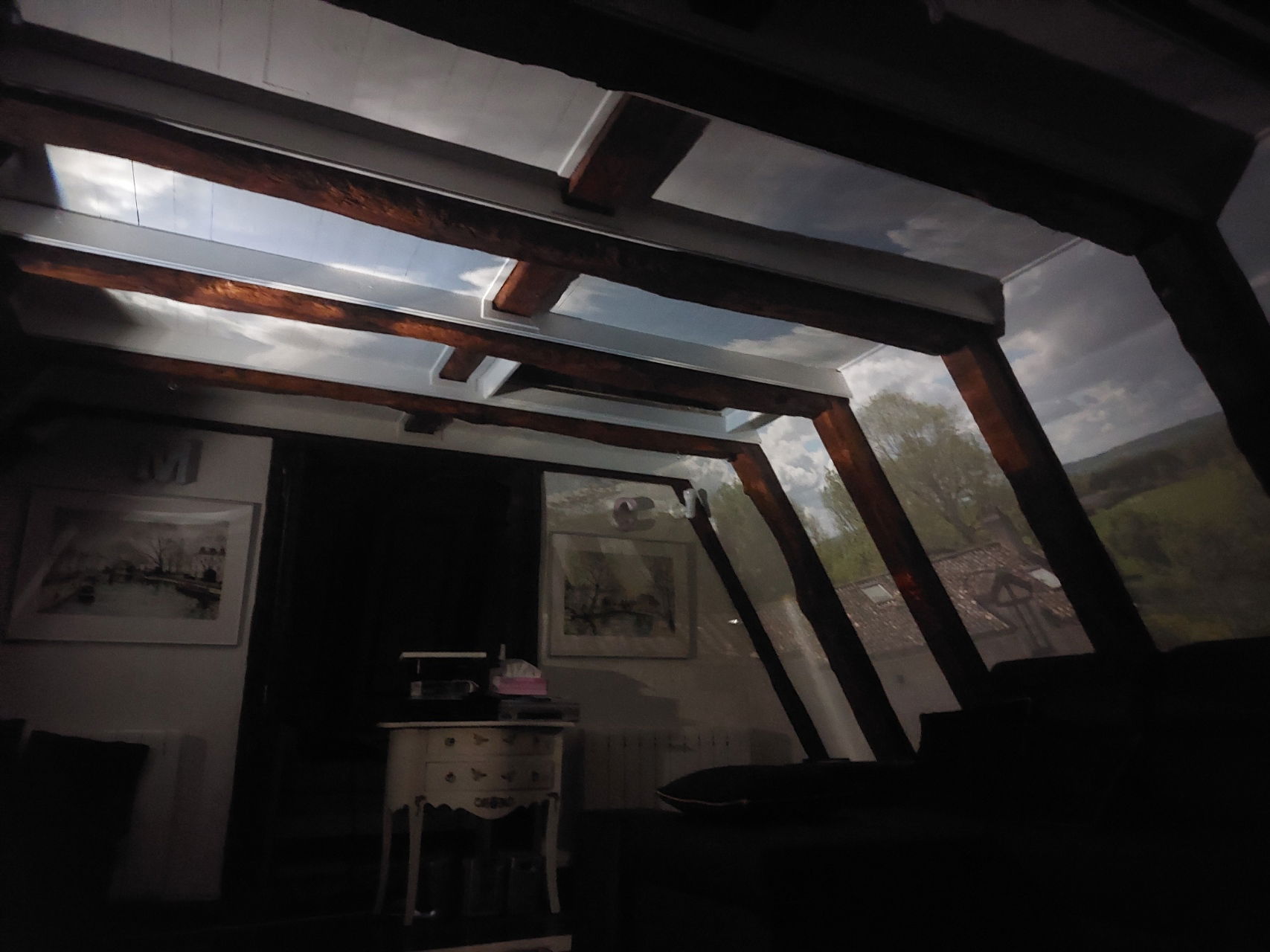
Another 'back story' installation from Brendan Bruce. Here the story is of the French Resistance, occupied France, an English 'guest' hidden in the attic room now occupied by the installation. For the full story see the display on the east wall (and below) Sloping attic walls covered in calligraphic hand-drawn cartridge paper panels (by the distinguished English philosopher Penny Hunt) of children's poems chosen by Brendan Bruce. Floor covered with glued and varnished pages from a poetry book. Framed wall-mounted backstory explanation exhibit containing a French wartime ID card and family photo. Poetry juke box, with CD of recordings made of Penny Hunt reading wall poems, recorded at the Radio Bomb/Capis recording studio by engineer Alex Lipman. "The Gigouzac Poetry Room": Created & Designed by Brendan Bruce The idea for a poetry room first started in 1987 when a workman removed the old corrugated iron roof of the old Niolle farmhouse at Gigouzac and found two identity cards (together with a photo of a young soldier; and 50 francs in notes, the equivalent in purchasing power to about 50 euros) wrapped in oilcloth and hidden in the rafters. He took them home with him as souvenirs and showed them to a friend of his grandmother's called Antoinette who had worked at Gigouzac during the war. She immediately recognised the woman in the photo but said that she was called Marie, not Suzanne as on the card. The farm workers had been told she was a cousin of the proprietor who had come to recuperate from an illness. She had stayed at Gigouzac for only about two months in the Spring of 1941 (before the Germans took over the whole of France in 1942, Gigouzac was in the Free Zone controlled by the collaborator Vichy government) using the attic as a bedroom, which in those days could only be reached by a ladder from the main bedroom below; and then disappeared abruptly without saying goodbye. Antoinette said that she mostly kept to herself in the attic, but on fine days often walked in the potager that used to be just in front of the house; and would sometimes stop and chat. The only other thing Antoinette could remember about 'Marie' was that she was fond of the farm's notoriously unfriendly cat, which brought her the rats he used to kill. She did say that the place in the attic where the card was found had been used during the German occupation by the farmer as a hiding place (created by piling up onions) mainly for black market items. Antoinette referred to her the 'L'Anglaise' because the farmer had once seen a scribbled piece of writing on one of the attic walls in English. She remembered that the farmer had been very angry with 'L'Anglaise' about this writing, and the woman had apologised profusely. Marie told Antoinette afterwards that it had been a favourite poem of her lover (the man in the photo?) and she had written it out because she was lonely. After extensive research it has been established that both the two identity cards are fake. ‘Suzanne Teyssier née Barat’ (supposedly born in Paris) and ‘Henriette Serre, née Fulminck’ (born Chamboulive in the Corrèze) never existed. Only two organisations had the resources to fake cards of this quality, the Resistance and SOE. Was ‘Marie’ English, or simply writing in English because her lover was English? If she was SOE why doesn't her photo appear in the records (there were fewer than 50 female agents in SOE)? While its true SOE used poems as recognition codes, their operatives were trained never to write them down, so she seems an unlikely candidate for a saboteur or wireless operator. Antoinette said that the visitor spoke 'like a foreigner', but when asked what that meant, she said 'like someone from from the North' (stranger and foreigner are the same word in French). This description also has an element (to a local peasant woman like Antoinette who would only have had a little elementary schooling) of an 'educated' accent. SOE only used Frenchwomen, or British subjects who spoke perfect French, so this might fit. The Resistance did use women sometimes, but usually only local women as couriers, so this role is unlikely. In any event, why would she have to hide out at Gigouzac? Who was she hiding from? Why did she never come back to Gigouzac to pick up the cards? There is speculation that she was both foreign-born and Jewish, someone who had fled the occupied zone and needed to be kept hidden from the local Gendarmerie. Vichy had passed anti-Jewish laws in 1940 (revoking French nationality and forbidding even French Jews from working in many professions like the civil service and journalism) and the gendarmes started rounding up and interning foreign Jews in October 1940, so if she were foreign born this would make both her flight and her hiding place understandable. Whoever she was, English or French; SOE or Resistance, a French Jew or foreign, or just someone running from trouble, 'L'Anglaise' was clearly a lover of poetry. Her little scribble on the wall, hastily destroyed by a scared and angry farmer over seventy years ago, has finally been replaced by twelve poems from the 1953 Puffin Children's Book of Verse, together with a floor full of other more adult favourites. On 22 May, 2014 Penny Hunt (who created the calligraphy for the wall poems), was at Alex Lipman's 'Capis' Studios to be recorded reading all twelve for the ‘Poetry Jukebox.’
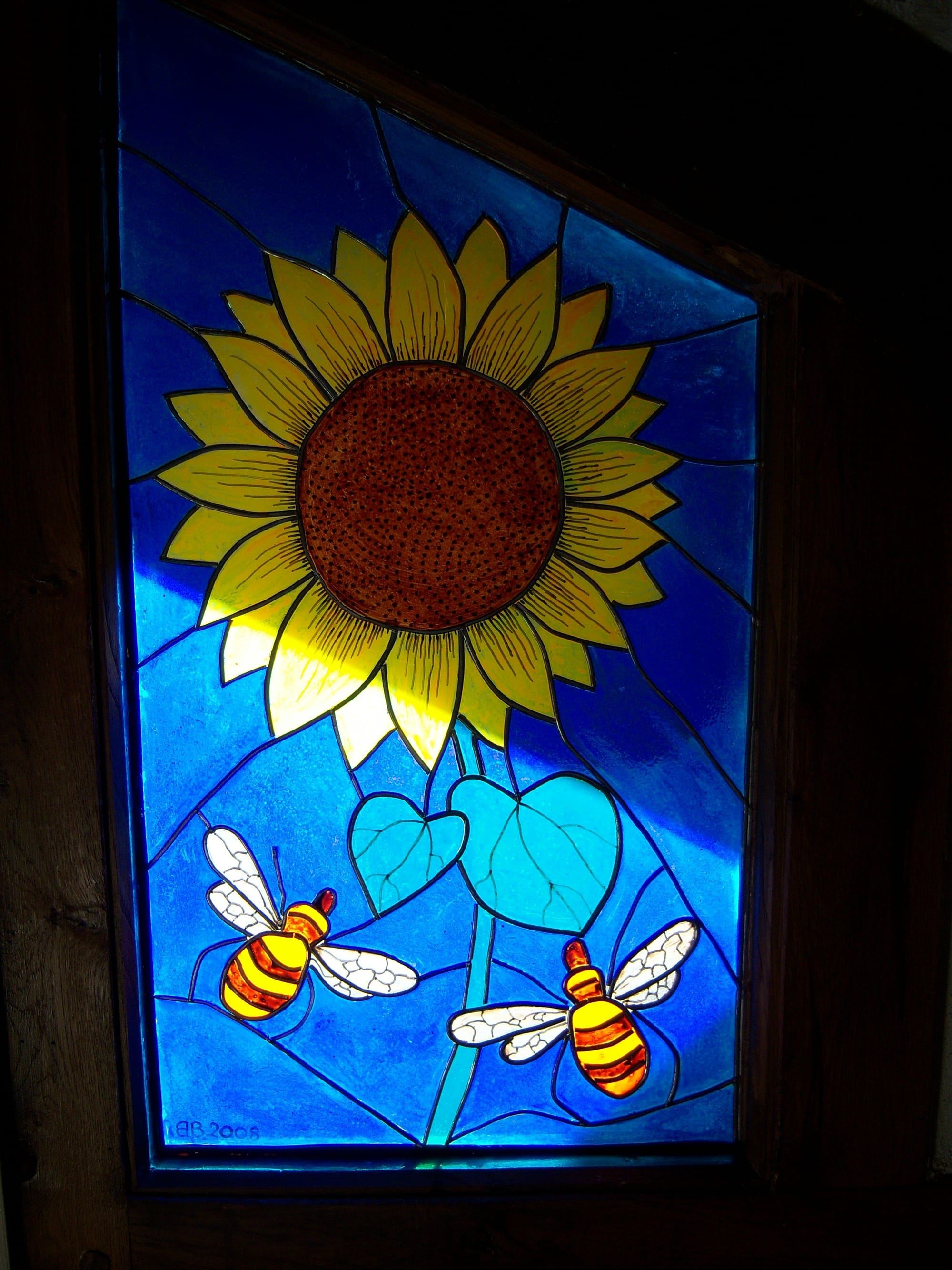
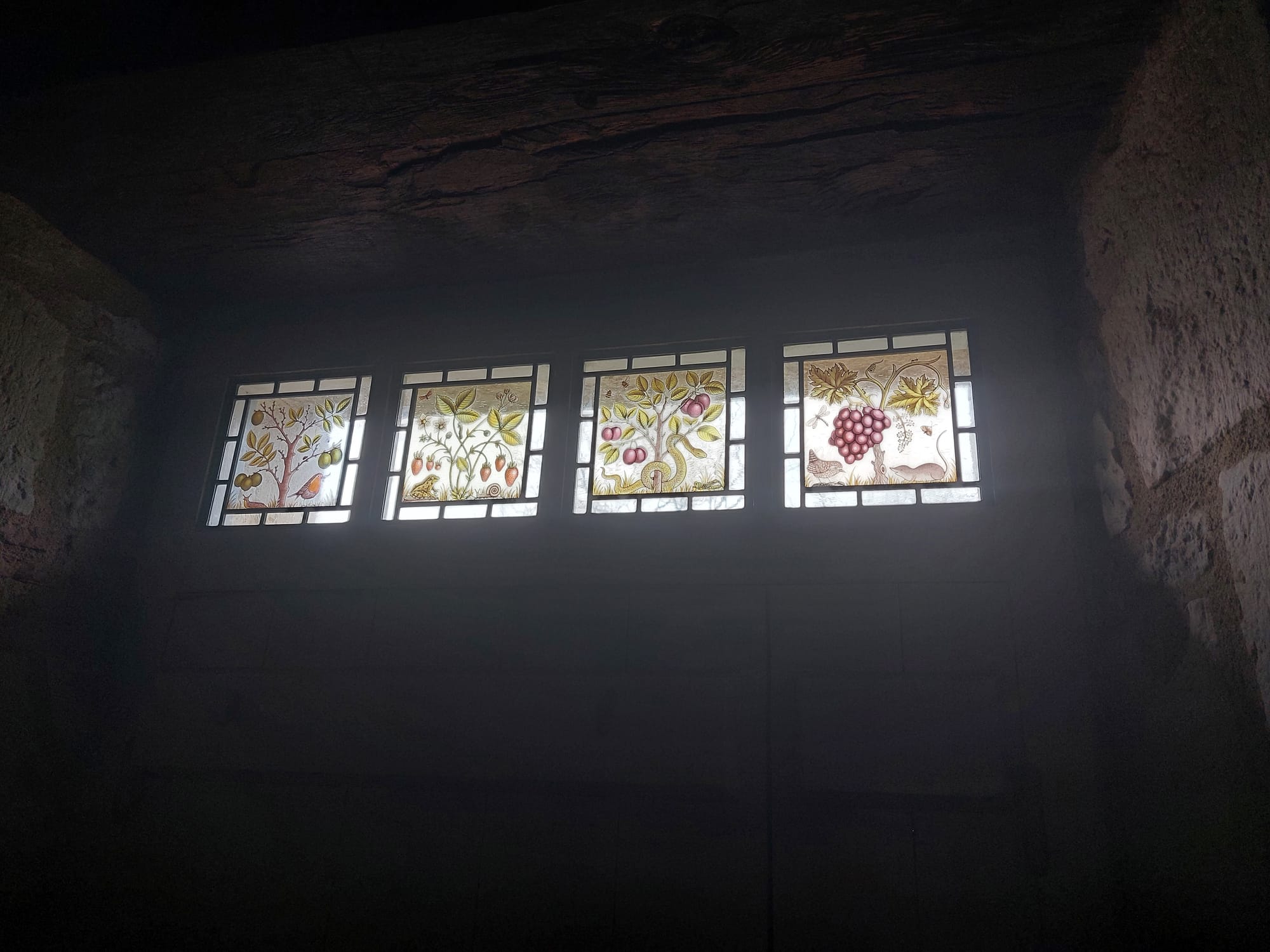
Commissioned by Brendan Bruce from the fantastically talented English stained glass artist, Flora Jamieson. It shows the plants, fruits, animals and birds (and bees) that inhabit the old potager at the Dominic Lagan Gallery.
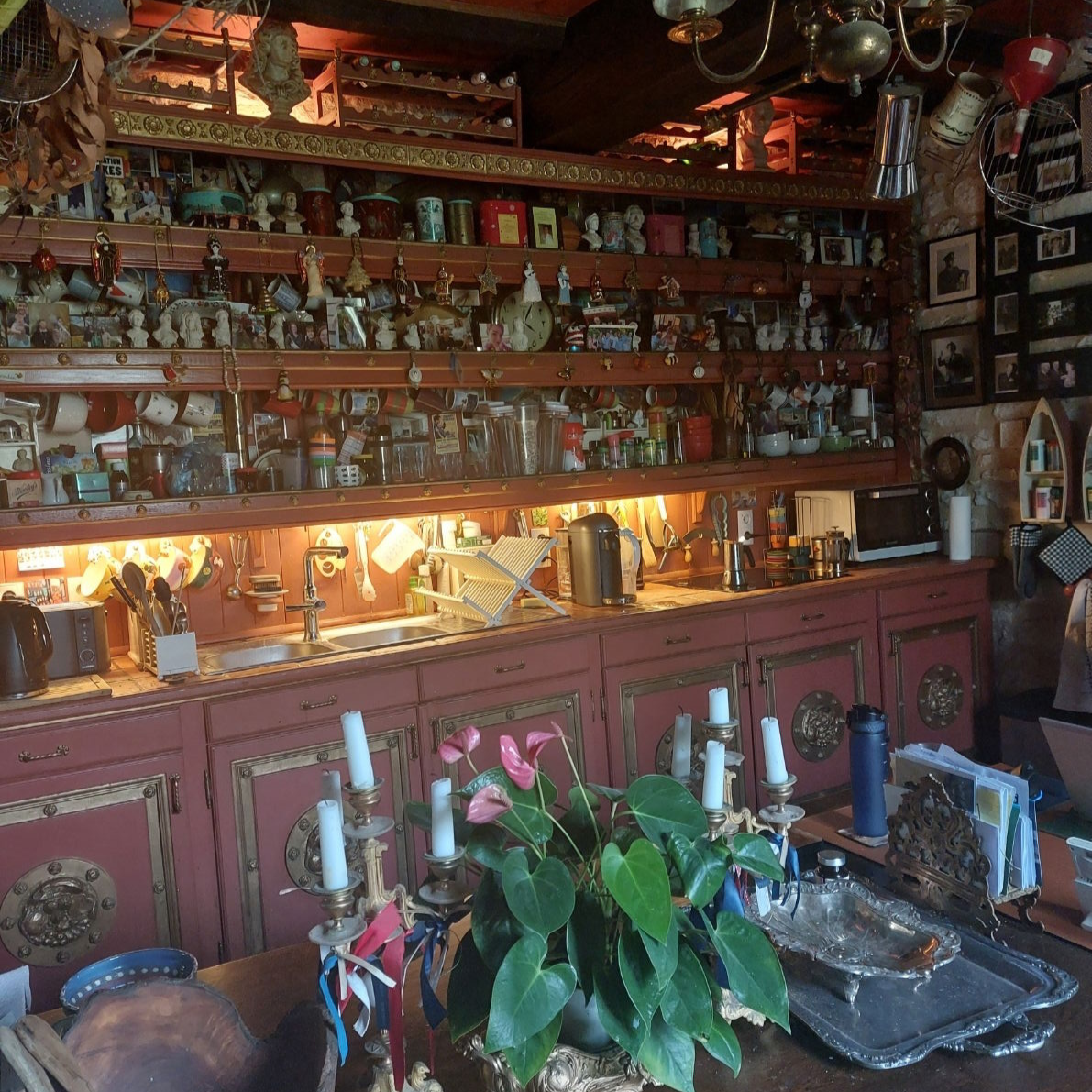
https://www.florajamieson.co.uk/traditional-stained-glassThis is a classic example both of Brendan Bruce's 'back story' installations, and his notion that even ordinary items eg in this case household furniture, can be turned into art, or even 'art'. The cabinets below were made by a local carpenter, and the roundels were created by Suzanne Shillingford as a tribute to the great ceramicist Bernard Palissy (1510–1590). The back story is that the dresser is part of a much longer piece of kitchen furniture from a large nearby chateau, and was saved from demolition by a piece of quick thinking. The dresser section is decorated with an air-dried plaster-based frieze to Brendan's design. It is decorated by hundreds of found objects, ranging from stuffed piranha to sterling silver advertising awards; from plaster busts, to F&M music boxes. It is festooned with hanging ornaments, gifts from friends, holiday souvenirs, postcards from his mother's travels, photographs and Christmas baubles. The two side pillars are covered in Campsis trumpet vines in flower, and the wall lizards, which are common in the courtyard water garden. On the third tier above the dresser and the cabinets are four wine racks decorated by gilded plastic heads of famous French figures from history (originally given away at petrol stations), and two antique busts of Messrs. Mansart and Arouet.
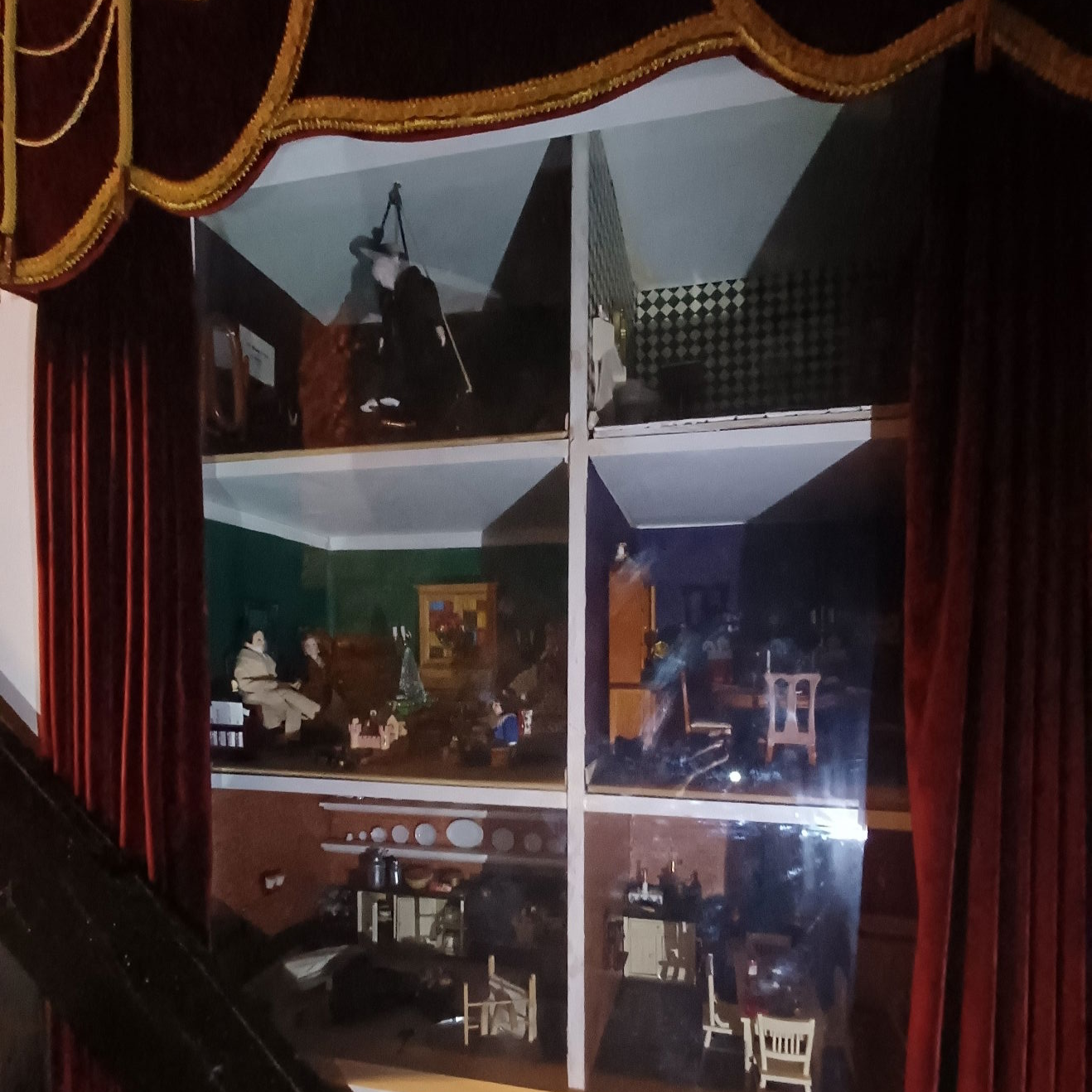
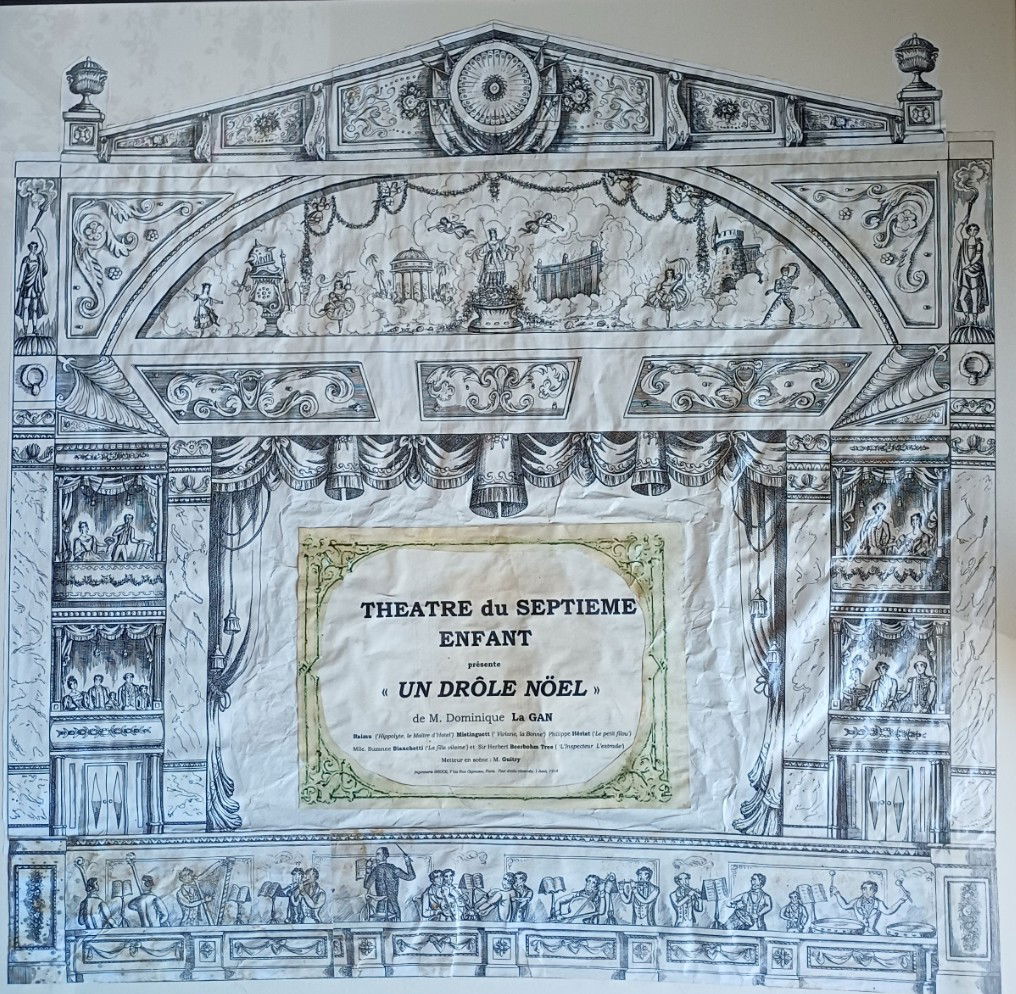
Installation by Brendan Bruce comprising a wooden box enclosing a model theatre. Fabric model figures and miniature furniture, electric lighting etc. Powered by mains transformer. Shows a scene purporting to be from a play entitled "Un Drôle Nöel. The scene shows a bourgeois family opening presents in the salon. In the basement kitchen, a female servant is lying dead, with (red wax) blood issuing from a fatal head wound. An axe is lying beside her. In an attic bedroom, a butler has hanged himself after removing his boots. An open wardrobe door in the bathroom exposes pornographic photographs. A framed vintage theatre poster describing the play, playwright and cast. Velvet opera curtains made by a professional coutière frame the model theatre box. Inspired by the artist's love of model theatres, and childhood visits to places with coin-operated mechanical models of scenes, e.g. skeletons in graveyards
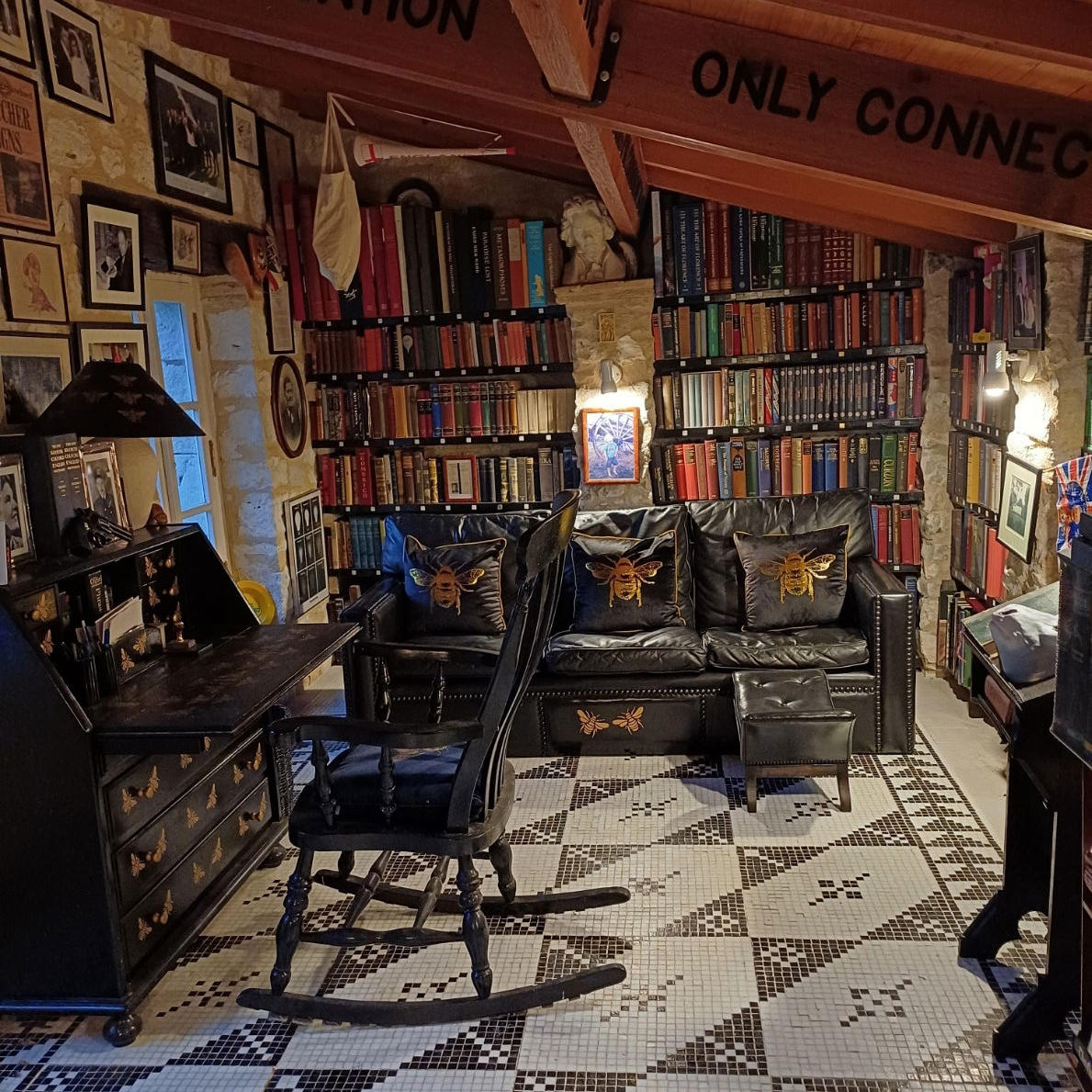
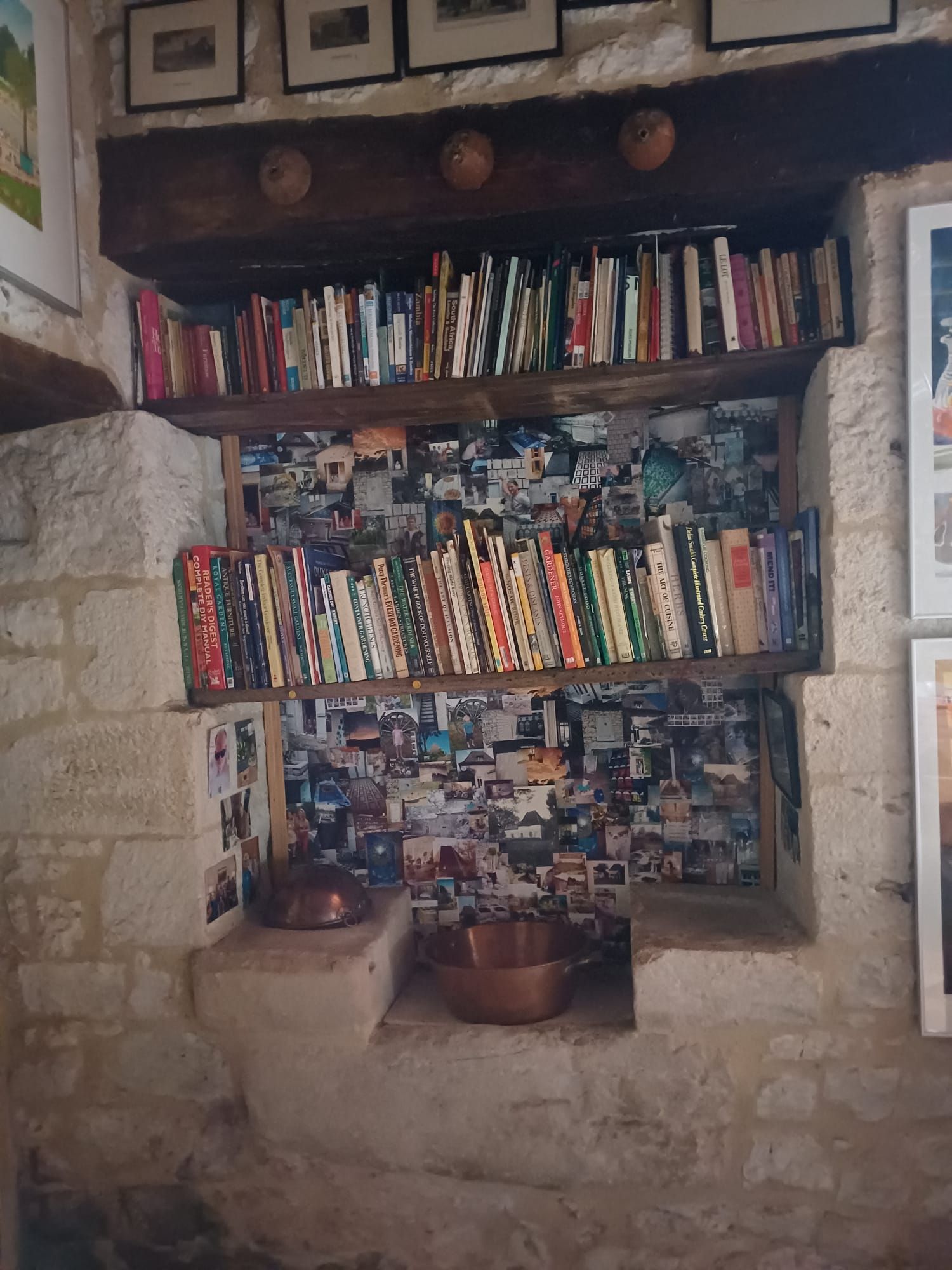
Designed and made by Brendan Bruce from black and white mosaic tesserae, glued to a reinforced concrete base using the Roman or mirror reverse method, where the tesserae are laid down in wooden trays, and the concrete poured over them. The main elongated star design was adapted from a small room at the imperial villa at Piazza Armerina in Sicily. The border pattern from a Roman villa in England. Note the mosaics let into the leading edge of the shelves, eight are white, but the seventh is gilded. This used to be two rooms with a wall dividing them. The near side was a chicken house. And the far end was the farm's lavatory (i.e. a plank, a hole, and a bucket), entered through what is now a window, replacing the original door. The quotations on the beams were inspired by Montaigne's tower study. Montaigne's chateau is located 80 kilometres to the north west of the Gallery.
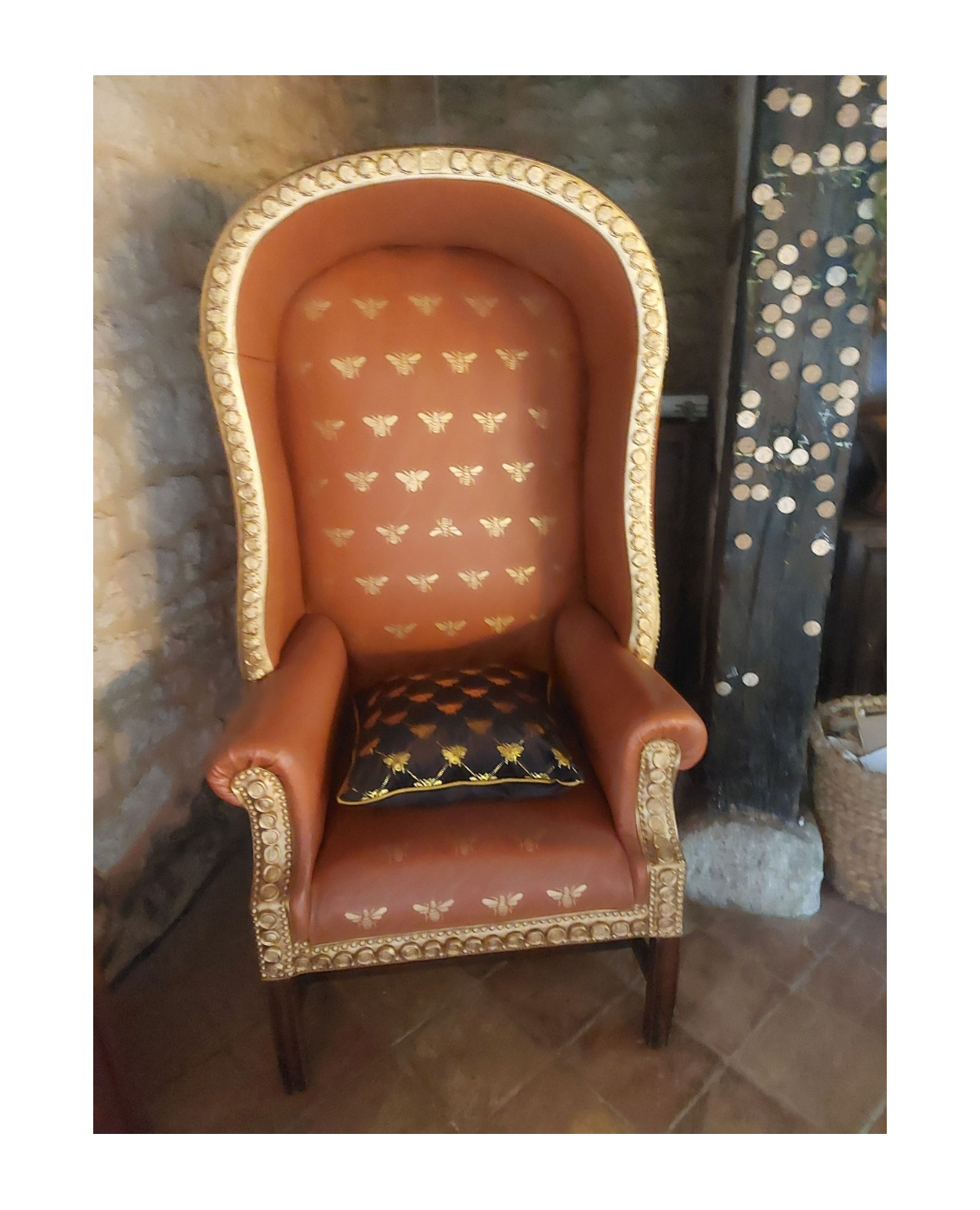
Né le 28 février 1533 au château de Montaigne en Périgord, Michel Eyquem de Montaigne est issu d'une famille de négociants bordelais. Son arrière grand-père, Ramon Eyquem, fait l'acquisition en 1477 de cette maison forte du XIVème siècle, et accède ainsi au noble statut de Seigneur de Montaigne qu'il lèguera à ses enfants et petits-enfants. De ces derniers, Pierre Eyquem est le premier à quitter le comptoir familial pour venir s'installer dans la demeure périgourdine qu'il fait aménager et fortifier. De son mariage avec Antoinette de Louppes, fille d'un marchand toulousain, il aura huit enfants dont Michel est l'aîné.A chair designed to be so grand, expensive and intimidating that nobody dares sit in it. Restored nineteenth porter's chair, re-covered by a professional French tapissière. Decorations in gold paint using a repetitive stencil pattern from a chalk cartoon type paper template designed by Brendan Bruce, using his two bees symbol; and in both air-dried and oven-baked plaster from silicon moulds and some hand moulding. Applied gilt trim, with brass bees. Monogrammed rosette emblems. Shop bought decorated cushion, with gilt bees.
Marine board, plastic edging. Made from grouted mosaic tessarae, broken glass, mirror glass and plastic mirror underlay. Signed. Edition of one. btw for White Lotus fans, the pine cone finial on top of the roof was bought from a shop in Taormina, and transported from there via Harley-Davidson to the Gallery. And the weather cock supposedly was made somewhere in the countryside around Aubagne. The reason why these weather vanes are in the form of a rooster is because Pope Gregory I regarded the cockerel as "the most suitable emblem of Christianity", being the emblem of Saint Peter (a reference to Luke 22:34 in which Jesus predicts that Peter will deny him three times before the rooster crows); and in the ninth century Pope Nicholas I ordered the figure to be placed on every church steeple.
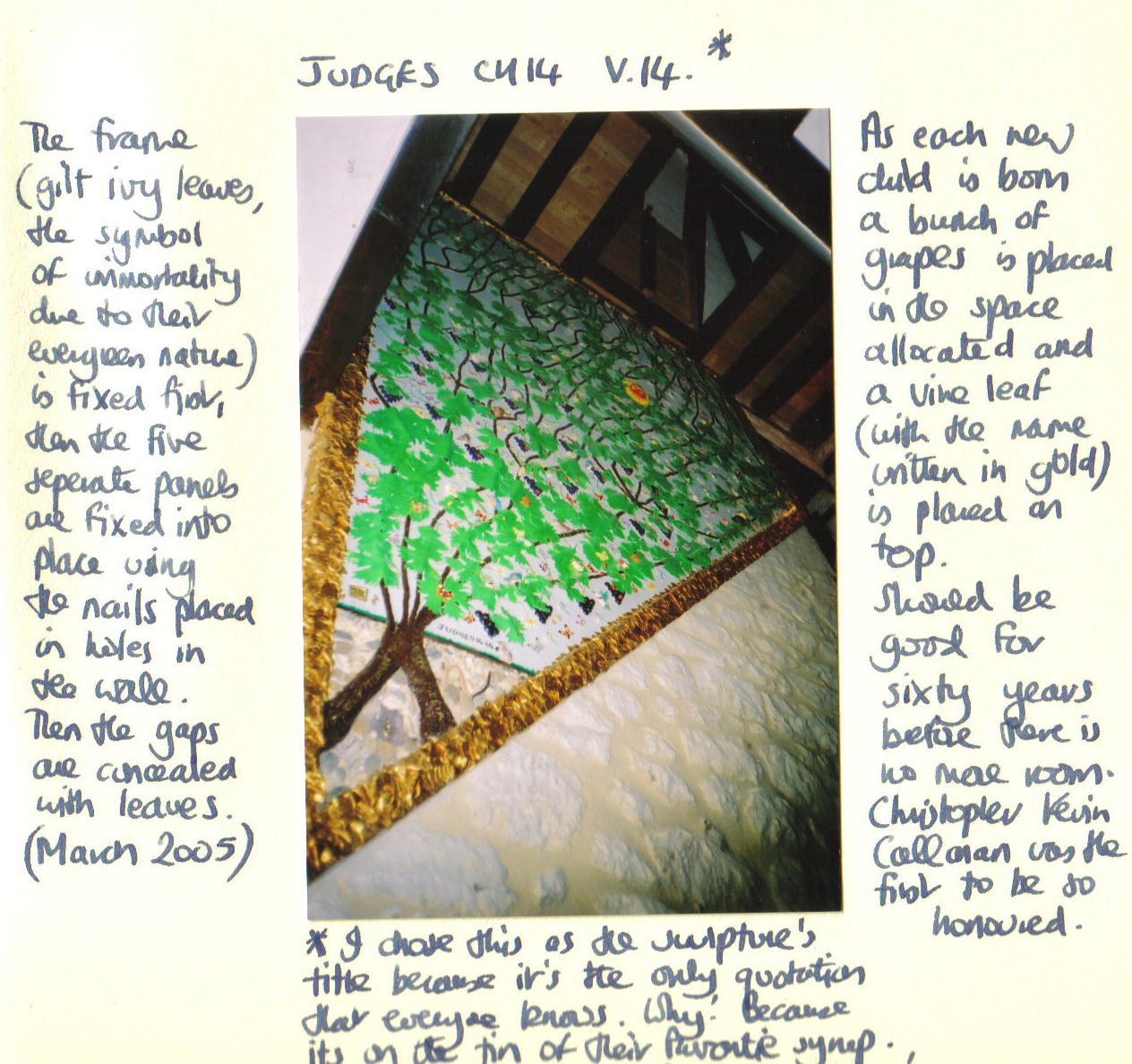
Lying in the sun on the Gallery's south terrace, Brendan Bruce noticed that the vine growing on the West Wing annexe was in the exact same triangular shape of the staircase wall. This gave him the idea of a 'living' installation, one that would change automatically over the years as new members of the family were born and added in the form of a vine leaf and bunch of grapes. Created out of hand moulded air-dried plaster, zinc nails, wood, gravel, wire, plasterboard in five sections, acrylic paint and varnish. Silicon moulds were used to create animals, birds, flowers and insects that one sees regularly in the old potager garden. Leaves with descendants' names in gilt pen. The inspiration for the fixing to the wall was the studded beef joint trolley at Simpsons-in-the-Strand. The vine includes all direct DNA sharing descendants of Dominic and Mary Bruce, including their nine children, grand children and great grand children This photo is from the set of albums that describe the history of the house.
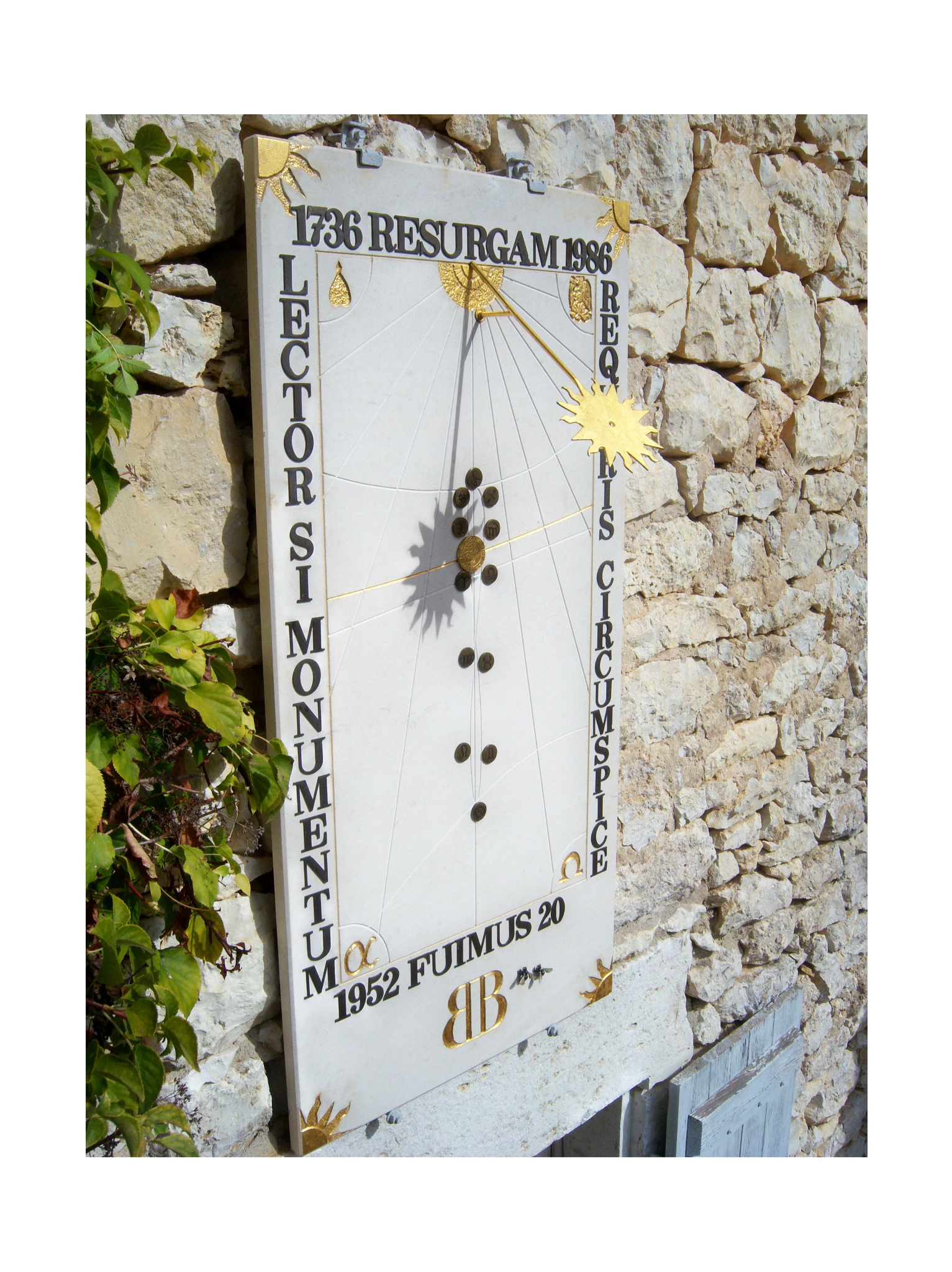
This installation was inspired firstly by something Bruce read in the Harleian Miscellany about a 17c court case regarding an epitaph written by a woman for the deceased husband she detested. Bruce asked the question: 'why do we let others draft the content of our tombstones?'. The second inspiration produced the form of the dial, mounted high on a wall; a sibling promised to 'dance on your grave', so this format was chosen to ensure that could not happen. It is a limestone tombstone in the form of a French 'noon dial', engraved by the English sundial specialist Geoff 'Pinky' Image in his workshop at Riberac. Shows Bruce's birthday each year by means of an engraved gilded line. It shows the hours of the day; months (by astrological signs), tropics, solstices, equinoxes etc The central gold medallion shows the place and year of birth, and includes a Chinese year of the Dragon symbol. It shows the dates of the building's renovations in 1736 and 1986, plus the Bruce clan motto. On Bruce's death, two digits will complete the installation. The epitaph is borrowed from Wren, and refers to how Bruce resurrected the building from certain decay and destruction. There is a time capsule buried in the wall behind the dial.
https://framacarte.org/fr/map/carte-des-cadrans-solaires-de-france-avec-photos_100006#19/44.58344/0.70766Another 'back story' based installation. Found early twentieth-century Irish confessional box, with a cassette recorder, and printed DIY instructions. For use in an installation video where guests are invited to make their confession, using the cassette recorder. The inspiration came from memories of making confessions as a child. Art is essentially self revelation, and the box was the earliest experience of that complex process of baring the soul, and telling secrets. A process which can be mysterious, frightening, cathartic. Concept Penitents enter and read an instruction notice. This is designed both for non-Catholics (aka Hell-bent heretics) to inform them of the procedure for making their confession, and to remind good Catholics (aka people on their way to Heaven deservedly). The children of Papal Knights are exempt, as (like on Earth), it's not what you've done, but who you know). Instruction Manual How to Confess Your Sins First of all, don’t be worrying if you haven't been to confession for a long time, I’m happy for you because heaven rejoices whenever a sinner turns to God and asks forgiveness. Remember the image of Christ the Good Shepherd who went out to seek the lost sheep and returned rejoicing to the other sheep carrying the sheep over His shoulders. If you can't recall what to do, or you get upset or flustered, just take deep breath and go on. God is listening to you and He knows what is in your heart. Instructions to record your confession. To get the machine going, press down on the button marked ‘Pause’. Then press down on the ‘Record’ button. Then, still pressing down on the two buttons, press the ‘Start’’ button. The machine is now ready to record your confession. When you are ready, release the ‘Pause’ button. You should hear the sound of the cassette as it moves. The machine is now recording your voice. Speak clearly and distinctly into the grille marked ‘Microphone’. There is no need to shout. Just speak normally as you would do as if I was present. You can pause the recording at any time by pressing the ‘Pause ‘button. When you ready to start speaking again, just release the ‘Pause’ button. Start your Confession by making the Sign of the Cross. In nomine Patris et Filii et Spiritus Sancti. Amen. (In the name of the Father and the Son and of the Holy Ghost. Amen.) “Bless me, Father, for I have sinned. It is (X days, weeks, months, years) since my last Confession. And these are my sins. Tell me the number and kind of your sins (mortal or venial, serious or not so serious), then say: “For these and all the sins of my past life, I ask pardon of God, penance, and absolution from you, Father.” ACT OF CONTRITION Now say a good Act of Contrition. “O my God, I am heartily sorry for having offended Thee, and I detest all my sins because I dread the loss of heaven and the pains of hell. But most of all because they offend Thee, who art all Good and worthy of all my love. And I firmly resolve, with the help of Thy grace, to confess my sins, to do penance, and to amend my life. Amen.” ABSOLUTION Dominus noster Jesus Christus te absolvat; et ego auctoritate ipsius te absolvo ab omni vinculo excommunicationis (suspensionis) et interdicti in quantum possum et tu indiges. [making the Sign of the Cross:] Deinde, ego te absolvo a peccatis tuis in nomine Patris, et Filii, et Spiritus Sancti. Amen. (May our Lord Jesus Christ absolve you; and by His authority I absolve you from every bond of excommunication and interdict, so far as my power allows and your needs require. Thereupon, I absolve you of your sins in the name of the Father, and the Son, and the Holy Spirit. Amen.) Passio Domini nostri Jesu Christi, merita Beatae Mariae Virginis et omnium sanctorum, quidquid boni feceris vel mail sustinueris sint tibi in remissionem peccatorum, augmentum gratiae et praemium vitae aeternae. (May the Passion of Our Lord Jesus Christ, the merits of the Blessed Virgin Mary and of all the saints and also whatever good you do or evil you endure merit for you the remission of your sins, the increase of grace and the reward of everlasting life. Amen.) When you are finished, please press the ‘Stop’ button. The machine will no longer record your voice. Then say to yourself one Our Father and one Hail Mary. Pax vobiscum (go in peace) ABSOLUTION IS AUTOMATICALLY GIVEN AT THIS POINT SPECIAL DISPENSATIONS WILL BE GIVEN FOR SOUND INFORMATION PRIOR TO THE KILLBEGGAN MEETINGS JUST RECORD YOUR TIPS HERE OR VISIT THE PAROCHIAL HOUSE AND GIVE THE INFORMATION (LONG ODDS ONLY) TO MAEVE CALLANAN God bless you all Fr Thomas Molloy This is the original concept note for the installation (An Irish confessional box of the period was purchased in County Galway and freighted to the Gallery by John Callanan) Extract from the Connemara Gazette CAN A MACHINE FORGIVE? WHEN AUTOMATION WAS ALL THE RAGE IN IRISH CHURCHES (BELLS, MUSIC) MANNION DEVELOPED AN AUTOMATED CONFESSIONAL BOX. HE CLAIMED IT HIS WOULD ALLOW PENITENTS TO COME AT ANY HOUR THEY PLEASED, AND TO ENCOURAGE THOSE EMBARASSED BY THE NATURE OF THEIR SINS, OR THE SHY, BUT IN TRUTH IT WAS DONE SO HE COULD GO AND PLAY GOLF PARISHIONERS RECORDED THEIR CONFESSIONS AND RECEIVED ABSOLUTION AND A PENANCE BY A SELF SELECTED MENU CHOICE PRESS A IF YOU THINK YOU DESERVE ABSOLUTION PRESS B IF YOU DON’T THINK YOU DESERVE ABSOLUTION THEN EXIT PRESS 1 FOR VENIAL SINS PRESS 2 FOR MORTALS SINS SELECT PENANCE TWO HAIL MARYS CATHOLICS ONLY GIVE DAYS' WAGE TO CHARITY 200 HOURS COMMUNITY SERVICE WEAR A SANDWICH BOARD SAYING A ROTTEN HUMAN BEING AND STAND OUTSIDE YOUR LOCAL SUPERMARKET FOR A DAY FORGIVE YOUR WORST ENEMY IT WAS USED IN THE CHURCH OF SAINT IGNATIUS CLIFDEN CONNEMARA UNTIL THE BISHOP ORDERED IT CLOSED SET UP A WEB SITE TO RESTORE AND DISPLAY THE BOX CROWDFUND THE SITE TO RECORD YOUR CONFESSIONS FOR FIVE POUNDS WHY DO WE NEED THIS? FEELING LIGHTER GETTING OFF CHEST MONKEY OFF BACK ANONYMOUS
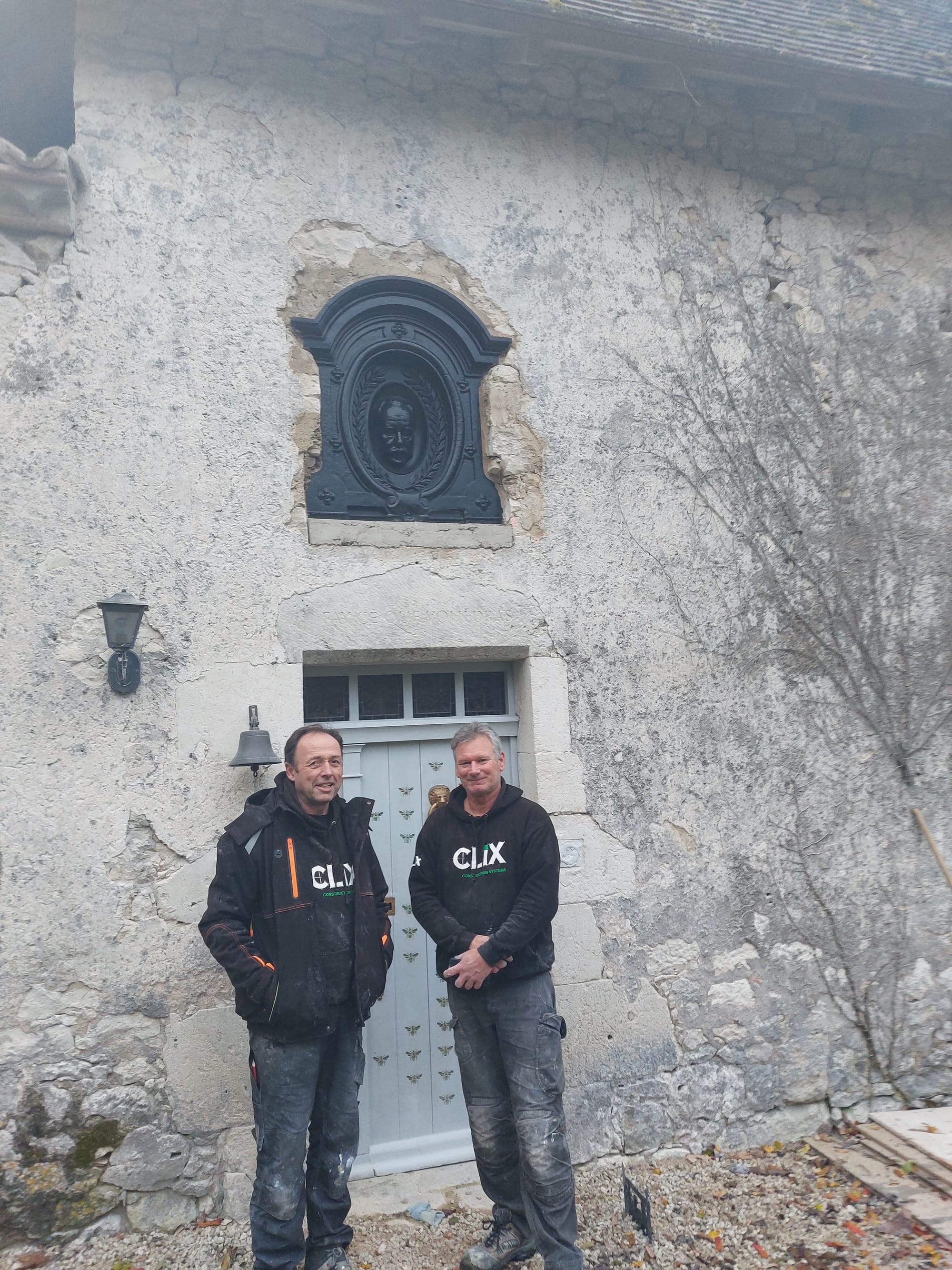
Nineteenth-century cast-iron dormer window surround from a chateau in Normandy, powder-coated in black. Bruce's head was constructed in resin after a 3D scan of his head carried out in London. The photo shows the masons who installed the extremely heavy plaque. This was taken in the brief moment when the head was exposed, before a mirrored plexiglass 'window' was installed, and wrought bars fixed to the surround. A time capsule was also installed behind the plaque. This is the only known photograph of the exposed head in situ.
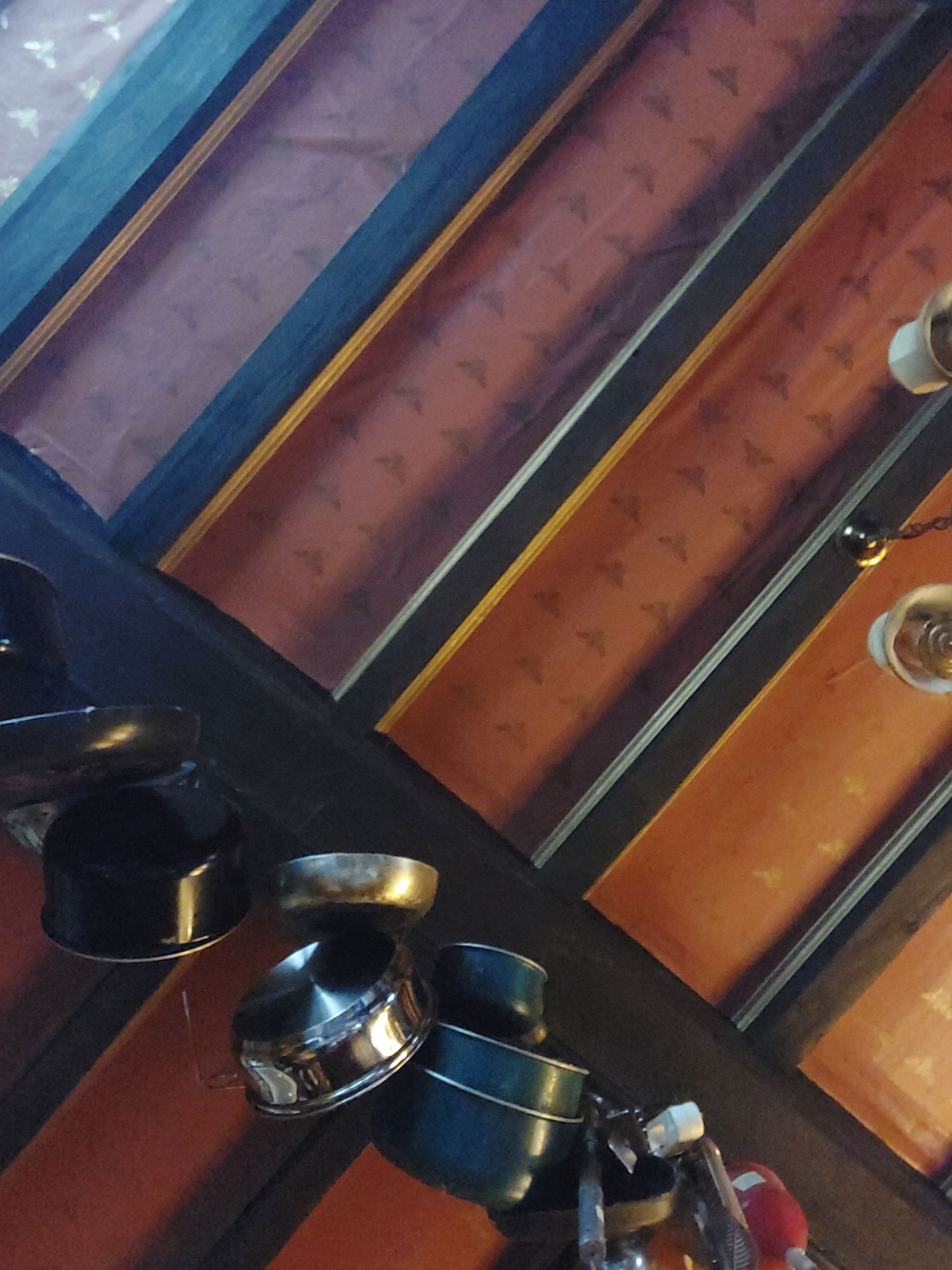
This installation was created as a byproduct of the sundial tombstone. The medallion has the exact longitude and latitude of Brendan Bruce's birth. That data, along with the exact time of the birth on March 6th, 1952, was fed into a computer programme to provide a star map of the night sky, i.e. what Bruce's mother, Mary Lagan Bruce, would have seen if the maternity hospital at Chiswick, London, had a transparent glass roof. Silver stars of various sizes were then glued onto wallpaper with a traditional blue ground, as used in medieval church ceilings, using the computer-generated map as a guide. A wood and plaster plaque was mounted over a nearby doorway and gives the technical details.
1940 forged ID cards; vintage photograph; bank notes. The Gigouzac Poetry Room: Created & Designed by Brendan Bruce The idea for a poetry room first started in 1987 when a workman removed the old corrugated iron roof of the old Niolle farmhouse at Gigouzac and found two identity cards (together with a photo of a young soldier; and 50 francs in notes, the equivalent in purchasing power to about 50 euros) wrapped in oilcloth and hidden in the rafters. He took them home with him as souvenirs and showed them to a friend of his grandmother's called Antoinette who had worked at Gigouzac during the war. She immediately recognised the woman in the photo but said that she was called Marie, not Suzanne as on the card. The farm workers had been told she was a cousin of the proprietor who had come to recuperate from an illness. She had stayed at Gigouzac for only about two months in the Spring of 1941 (before the Germans took over the whole of France in 1942, Gigouzac was in the Free Zone controlled by the collaborator Vichy government) using the attic as a bedroom, which in those days could only be reached by a ladder from the main bedroom below; and then disappeared abruptly without saying goodbye. Antoinette said that she mostly kept to herself in the attic, but on fine days often walked in the potager that used to be just in front of the house; and would sometimes stop and chat. The only other thing Antoinette could remember about 'Marie' was that she was fond of the farm's notoriously unfriendly cat, which brought her the rats he used to kill. She did say that the place in the attic where the card was found had been used during the German occupation by the farmer as a hiding place (created by piling up onions) mainly for black market items. Antoinette referred to her the 'L'Anglaise' because the farmer had once seen a scribbled piece of writing on one of the attic walls in English. She remembered that the farmer had been very angry with 'L'Anglaise' about this writing, and the woman had apologised profusely. Marie told Antoinette afterwards that it had been a favourite poem of her lover (the man in the photo?) and she had written it out because she was lonely. After extensive research it has been established that both the two identity cards are fake. ‘Suzanne Teyssier née Barat’ (supposedly born in Paris) and ‘Henriette Serre, née Fulminck’ (born Chamboulive in the Corrèze) never existed. Only two organisations had the resources to fake cards of this quality, the Resistance and SOE. Was ‘Marie’ English, or simply writing in English because her lover was English? If she was SOE why doesn't her photo appear in the records (there were fewer than 50 female agents in SOE)? While its true SOE used poems as recognition codes, their operatives were trained never to write them down, so she seems an unlikely candidate for a saboteur or wireless operator. Antoinette said that the visitor spoke 'like a foreigner', but when asked what that meant, she said 'like someone from from the North' (stranger and foreigner are the same word in French). This description also has an element (to a local peasant woman like Antoinette who would only have had a little elementary schooling) of an 'educated' accent. SOE only used Frenchwomen, or British subjects who spoke perfect French, so this might fit. The Resistance did use women sometimes, but usually only local women as couriers, so this role is unlikely. In any event, why would she have to hide out at Gigouzac? Who was she hiding from? Why did she never come back to Gigouzac to pick up the cards? There is speculation that she was both foreign-born and Jewish, someone who had fled the occupied zone and needed to be kept hidden from the local Gendarmerie. Vichy had passed anti-Jewish laws in 1940 (revoking French nationality and forbidding even French Jews from working in many professions like the civil service and journalism) and the gendarmes started rounding up and interning foreign Jews in October 1940, so if she were foreign born this would make both her flight and her hiding place understandable. Whoever she was, English or French; SOE or Resistance, a French Jew or foreign, or just someone running from trouble, 'L'Anglaise' was clearly a lover of poetry. Her little scribble on the wall, hastily destroyed by a scared and angry farmer over seventy years ago, has finally been replaced by twelve poems from the 1953 Puffin Children's Book of Verse, together with a floor full of other more adult favourites. On 22 May, 2014 Penny Hunt (who created the calligraphy for the wall poems), was at Alex Lipman's 'Capis' Studios to be recorded reading all twelve for the ‘Poetry Jukebox.’
A devise notionally taken from the Abbaye de Thélème in 'Gargantua' by Rabelais. 'Fais ce que voudras' translates into modern English as 'Do what you wish.' It was engraved directly into the lintel by Rodolphe Giuglardo. Like Trump, visitors should take it seriously, but not literally.
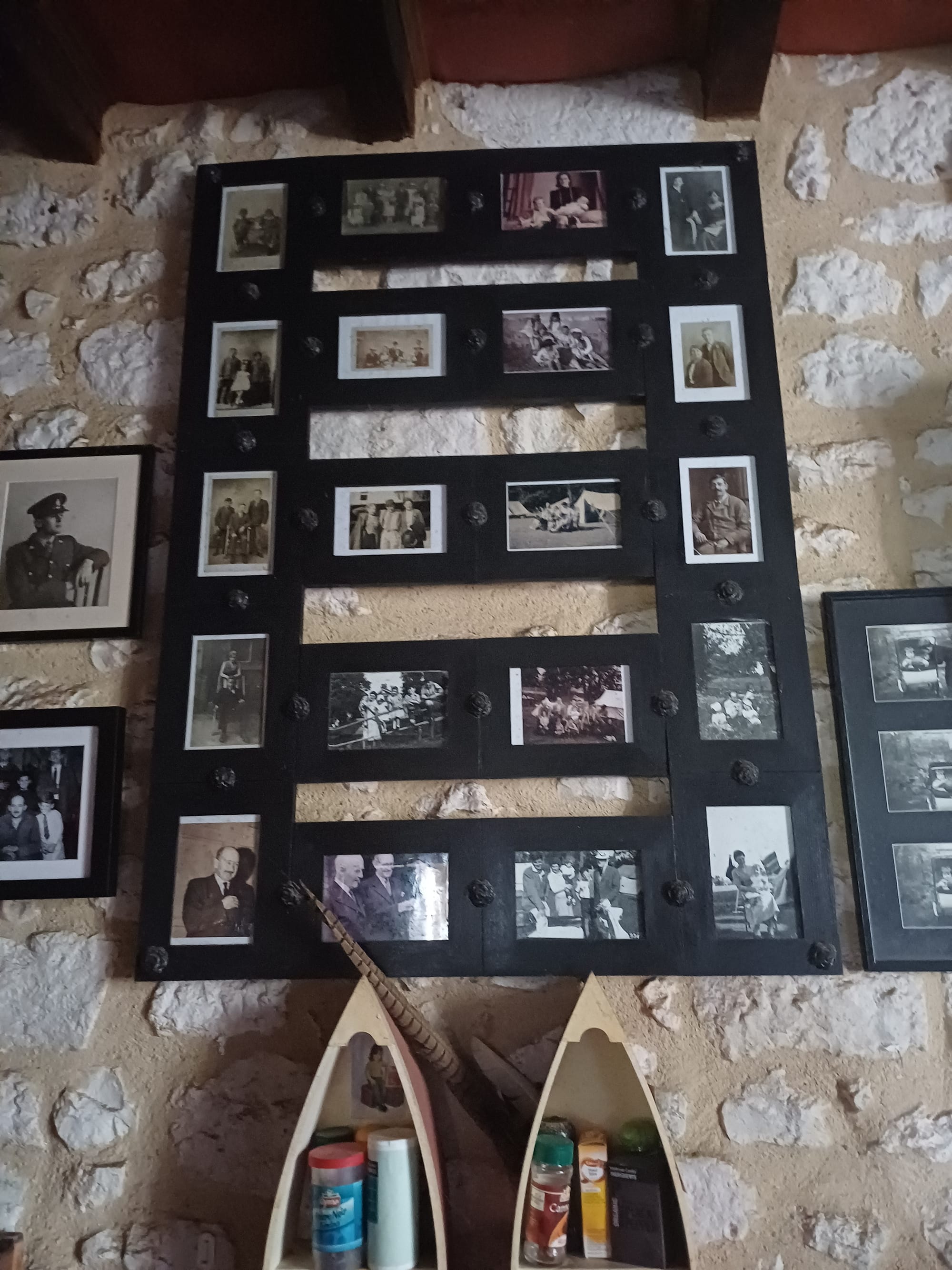
https://www.bacdefrancais.net/gargantua-rabelais-theleme-57.phpThis work consists of old black and white family photos positioned in wooden fames and screwed/glued together. It was inspired firstly by a conversation Brendan Bruce had with his frail old aunt Anne Bruce Kimber in a nursing home some time just before her death. Her mind was still quite sharp, especially about matters long ago. Bruce showed her the pile of old photos, and this provoked her to talking about the people in them. When she got to the man in the 'wounded' uniform (men wore these during WWI to show they had come from the front and were not malingering/cowardly) centre right on the work, she exclaimed "oh, that's Uncle Tommy Campbell!". Bruce asked her who he was. But his aunt just shook her head silently. So, while his identity remains a mystery to this day, he is still remembered. And that connects to the second inspiration, a poem by one of Bruce's favourite poets of his teenage years, Brian Patten, entitled "So Many Different Lengths Of Time." In it, Patten makes the point that: "A man lives for as long as we carry him inside us, for as long as we carry the harvest of his dreams, for as long as we ourselves live, holding memories in common, a man lives." So Tommy Campbell lives, in our hearts. This work is dedicated to Richard Elphicke, the Fourth Man in the 'Four Men in a Boat' group of friends. He also is not gone from the boat, at least not until the other three leave in their turn. The third inspiration was Jon Lord's song 'Pictured within', and the memories we all have of the most important people in our lives.
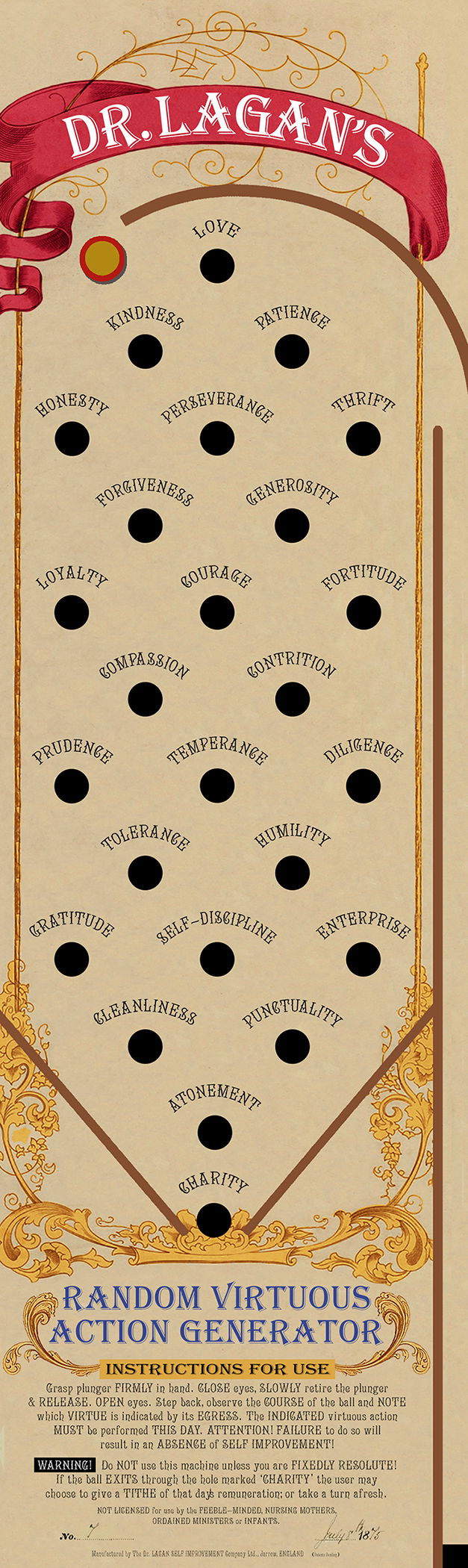
How long does a man live after all? A thousand days or only one? One week or a few centuries? How long does a man spend living or dying and what do we mean when we say gone forever? Adrift in such preoccupations, we seek clarification. We can go to the philosophers but they will weary of our questions. We can go to the priests and rabbis but they might be busy with administrations. So, how long does a man live after all? And how much does he live while he lives? We fret and ask so many questions - then when it comes to us the answer is so simple after all. A man lives for as long as we carry him inside us, for as long as we carry the harvest of his dreams, for as long as we ourselves live, holding memories in common, a man lives. His lover will carry his man's scent, his touch: his children will carry the weight of his love. One friend will carry his arguments, another will hum his favourite tunes, another will still share his terrors. And the days will pass with baffled faces, then the weeks, then the months, then there will be a day when no question is asked, and the knots of grief will loosen in the stomach and the puffed faces will calm. And on that day he will not have ceased but will have ceased to be separated by death. How long does a man live after all? A man lives so many different lengths of time. Brian PattenAnother 'back story' installation by Brendan Bruce. This shows the printed poster background to the enclosed glass of a large bagatelle (the forerunner of the modern pinball machine). It is designed to be used as it was originally, e.g. at fairs and markets, on the back of a cart or wain. An unrealised variant installation idea is to adapt a 'one arm bandit' slot machine to achieve the same result. In a gallery environment, the queue would be organised by a rope line, they would be given a copy of the user's manual, they would then mount the cart steps (as if going up to the guillotine), read the instructions, ask any questions of the attendant, pull the plunger and note which hole the ball went down. The attendant will note down the result. The experience will be filmed by robot cameras. Users Manual The Virtuous Action Generator was conceived and created by Brendan Bruce. It was designed to answer the question: can machines do good? Up to now machines were not thought to have any inherent moral good. They can improve people’s lives, but seemingly only by the agency of an human intervention. With the growth of artificial intelligence and sophisticated robotics the debate around machines has centred on whether they will create a dystopia where humans are subservient to machines. But can machines reverse the proposition and direct humans to do good? To create randomness, which means the human intervention is not purposeful or fraudulent, the bagatelle format is used. By configuring the number of holes and the placement of the nails, the ball’s path cannot be manipulated or predicted. Thus the machine is making the choice of virtue, rather than the human. By agreeing to be bound by the machine’s conditions, the human performs the virtuous action the machine indicates. The machine is therefore responsible for a change in human behavior, a change for good. Method 1. The human approaches the machine and reads the instructions. 2. They agree to abide by these conditions by means of a verbal agreement with themselves. 3. They close their eyes, pull the plunger back and then release. 4. They open their eyes to follow the path of the ball and note into which hole the ball goes. 5. They perform the virtuous action indicated by the hole’s label within twenty four hours of pulling the plunger. 6. If the ball goes into the hole marked ‘Charity’ at the bottom of the machine, they may choose to give one tenth of the gross income they make that day to the charity of their choice; or pull the plunger once again and repeat the process. 7. The human then receives the return on their action in the form of good kharma. Copyright Brendan Bruce 2026 Here's the back story draft DR. LAGAN’S RANDOM VIRTOUS ACTION GENERATOR: MACHINE NUMBER SEVEN This is an extract from “Curiosities of Old Jarrow” by John Mannion, published by Mannion Books, Second Revised Edition with Illustrations, South Shields, 1982, ISBN 978-0749406691, pp 67-68. “Dr. Lagan’s ‘Self Improvement’ company was established in Monkton Village, Jarrow, County Durham in 1870 to manufacture his Celebrated ‘Self Improvement’ Plant Tonic (‘The Tonic That Does You Good’) which was sold to temperance teetotallers, mainly in the North East. Joseph Lagan was a local man, born in Boldon Colliery, who had family in Jarrow. They told him about a derelict barn for sale which he then bought at auction and fitted out as a bottling plant, complete with tanks full of the secret plant recipe for his Tonic, which was originally based on an elixir of his grandmother’s used to treat insomnia, the main ingredient being Viola Odorata, or Wood Violet. However, that version was changed when it was realised that the recipe contained small amounts of belladonna. After a poor start for sales of the miraculous Tonic, the landlord of the Lord Nelson public house suggested that Dr. Lagan (there is no evidence that ‘Dr.’ Lagan had any formal medical qualifications) use more flamboyant marketing methods to get publicity for his Tonic, similar to those that the breweries used to ensure their ales were stocked by pubs. Following a suggestion of his wife, the formidable Brigid Melia Lagan, whose father had been fond of playing with the family bagatelle, the good Doctor conceived of his ‘Random Virtuous Generator,’ which was built to get publicity for his Tonic at markets and fairs. The design was taken from the label of the Tonic bottle. Feeling it was undignified for him to personally exhibit the Generator, Dr. Lagan hired a defrocked Baptist preacher to accompany the converted dray painted in green and gold on which the Generator was transported by two magnificent matched grey Shire stallions to places where the public congregated, such as temperance bars, markets and fairs, even on occasion outside public houses. Potential Tonic customers were encouraged to climb up the steps placed at one end of the four wheeled trolley, and pull the plunger on the Generator (which was bolted firmly to a stanchion on the flat bed) and promise to carry out the virtuous action indicated by which hole the ball entered. They were then persuaded that the virtuous action that the machine mandated would be enhanced by a generous draught of the celebrated tonic, with its ‘sixteen varieties of herbal plants’ including Smilax Ornata, a known treatment for syphilis. According the company’s archives (it went out of business in 1914 when Lagan’s nephew, who inherited the business, went off to War) only ten full sized machines were completed. In addition, an unknown number of scaled down ‘table top’ models were built for use in temperance bars as part of Lagan’s merchandising plan to get them to stock the Tonic. They were built in Lagan’s own factory workshop by his joiners mostly using stock materials (for example, the plunger handle was sourced, according to the invoice, from a local cabinet maker’s stock of drawer handles); while the back paper was designed by a typographer from a printing firm at South Shields. The box itself is painted pine and has been extensively repaired at some time during its working life. The Generator’s public appearances were often advertised in advance in the Shields Gazette; and it became a familiar sight in the County and even beyond. Most of them (perhaps all, except Number Seven, which is in private hands) have since disappeared. Machine Number Seven was built in 1876 to replace Machine Number Three which was destroyed in a fire at the works. The handle and plunger on Number Seven is supposed to have been the one originally from Machine Number Three after it was rescued from the ashes. Machine Number Nine was converted into a fairground game and was in use up to the 1950’s in Ghent. The Generator worked well as a sales gimmick; and the Tonic furnished Lagan with a good living. It was often sold on commission through Temperance Bars and Methodist Church bazaars, picnics and hayrides. Lagan died in 1905 at the then relatively advanced age of seventy five (an advert for his Tonic?) and is buried in Hebburn with Brigid by his side. She outlived him by thirty years.” © John Mannion 1982 The photograph in Mannion’s book facing page 68, is the only known published reference showing the Random Virtuous Action Generator in action. Despite rumours of Machine Number Five being sent for sale by auction in Adelaide during the late eighties and then being suddenly withdrawn, Machine Number Seven is thought to be the only survivor of the original ten machines built, numbered and dated by Dr. Lagan in his Jarrow factory. Examples of the quarter size ‘table top’ model (which were in fact used wall-mounted) turn up from time to time in specialist auctions. This half pint bottle is an example of the ‘improved’ recipe version, in which Acorus Calamus or Sweet Flag, had been added. This was sold from 1903 to 1914 for 7/6d, a considerable sum at the time. Ironically, given the Tonic was aimed at teetotallers, research shows that it was in fact a re-purposed beer bottle, which Lagan bought discreetly in bulk from a local brewery. The colour was apparently chosen to disguise the fact that the Tonic had an alarming habit of turning a sickly green when exposed to sunlight. Original back story draft DR LAGAN’S RANDOM VIRTOUS ACTION GENERATOR: MACHINE NUMBER SEVEN This is an extract from “Curiosities of Old Jarrow” by John Mannion, self published by Mannion Books, Second Revised Edition with Illustrations, South Shields, 1982, ISBN 978-0749406691, pp 67-68. “Dr Lagan’s ‘Self Improvement’ company was established in Monkton Village, Jarrow, County Durham in 1870 to manufacture his Celebrated ‘Self Improvement’ Plant Tonic (‘The Tonic That Does You Good’) which was sold to temperance teetotallers in the North East. Joseph Lagan was a local man, born in Boldon Colliery, who had family in Jarrow. They told him about a derelict barn for sale which he then bought at auction and fitted out as a bottling plant, complete with tanks full of the secret plant recipe for his Tonic, which was originally based on an elixir of his grandmother’s used to treat insomnia, the main ingredient being Viola Odorata, or Wood Violet. However, that version was changed when it was realised that the recipe contained small amounts of belladonna. After a poor start for sales of the miraculous Tonic, the landlord of the Lord Nelson public house suggested that Dr Lagan (there is no evidence that ‘Dr’ Lagan had any formal medical qualifications) use more flamboyant marketing methods to get publicity for his Tonic, similar to those that the breweries used to ensure their ales were stocked by pubs. Following a suggestion of his wife, the formidable Brigid Melia Lagan, whose father had been fond of playing with the family bagatelle, the good Doctor conceived of his ‘Random Virtuous Generator,’ which was built to get publicity for his Tonic at markets and fairs. The design was taken from the label of the Tonic bottle. Feeling it was undignified for him to personally exhibit the Generator, Dr. Lagan hired a defrocked Baptist preacher to accompany the converted dray painted in green and gold on which the Generator was transported by two magnificent matched grey Shire stallions to places where the public congregated, such as temperance bars, markets and fairs, even on occasion outside public houses. Potential Tonic customers were encouraged to climb up the steps placed at one end of the four wheeled trolley, and pull the plunger on the Generator (which was bolted firmly to a stanchion on the flat bed) and promise to carry out the virtuous action indicated by which hole the ball entered. They were then persuaded that the virtuous action that the machine mandated would be enhanced by a generous draught of the celebrated tonic, with its ‘sixteen varieties of herbal plants’ including Smilax Ornata, a known treatment for syphilis. According the company’s archives (it went out of business in 1914 when Lagan’s nephew, who inherited the business went off to the War) only ten machines were completed. The Generator’s public appearances were often advertised in advance in the Shields Gazette; and it became a familiar sight in the County and even beyond. Most of them (perhaps all except Number Seven, which is in private hands) have since disappeared. Machine Number Seven was built in 1876 to replace Machine Number Three which was destroyed in a fire at the works. The handle and plunger on Number Seven is supposed to have been the one originally from Machine Number Three after it was rescued from the ashes. Machine Number Nine was converted into a fairground game and was in use up to the 1950’s in Ghent. The Generator worked well as a sales gimmick; and the Tonic furnished Lagan with a good living. It was often sold on commission through Temperance Bars and Methodist Church bazaars, picnics and hayrides. Lagan died in 1905 at the then relatively advanced age of seventy five (an advert for his Tonic?) and is buried in Hebburn by Brigid’s side. She outlived him by thirty years.” © John Mannion 1982 The photograph in Mannion’s book facing page 68, is the only known published reference proving the existence of the Random Virtuous Action Generator. Despite rumours of Machine Number Five being sent for sale by auction in Adelaide during the late eighties and then being suddenly withdrawn, Machine Number Seven is thought to be the only survivor of the original ten machines built and signed by Dr. Lagan in his Jarrow factory. This half pint bottle is an example of the ‘improved’ recipe version, in which Acorus Calamus or Sweet Flag, had been added. This was sold from 1903 to 1914 for 7/6d, a considerable sum at the time. Ironically, given the Tonic was aimed at teetotallers, research shows that it was in fact a re-purposed beer bottle, which Lagan bought discreetly in bulk from a local brewery. The colour was apparently chosen to disguise the fact that the Tonic had an alarming habit of turning green when exposed to sunlight. Label Dr. LAGAN’S Celebrated ‘Self Improvement’ Plant TONIC ‘The Tonic That Does You Good’ Sixteen Varieties of Improving Herbal Plants. New Improved Temperance Elixir with Miraculous Results! Tincture Free! Safe for Infants! Twice Macerated Herbal Extracts & Decoctions from the Ancient Orient Help Cure Insomnia and Nightmares. Also, Inveterate Lassitude or Torpor, Lack of Vigour, Nervous Exhaustion, Idle Thoughts, Distracted Waywardness, Low Spirits, Gloomy Notions, Lethargic Indifference and Chronic Procrastination. As Taken by the Royal Houses of Europe. Recommended by Ministers and Clerics for all ages. Half pint. 7/6d. One tablespoon thrice daily after meals. Maybe also taken as an infusion or steam inhalation. The Dr. LAGAN SELF IMPROVEMENT Company Ltd, Jarrow, England. Use Wood Violet as the graphic http://www.fentimans.com/history#
This is an as yet unrealised installation. It is built like a film set. The hotel style is an ordinary chain hotel. This is the original concept note HOTEL INSTALLATION RECEPTION FROM SET RECEPTIONIST IN COSTUME SECURITY SCREENS SHOWING PARTICIPANTS (actors) EXCEPT ROOM 8 WHICH SHOWS THEATRE SCENE RECORDING OF A VIOLENT ALTERCATION EITHER VIEWERS CAN WATCH THE SCREENS (ONE OR TWO OF WHICH SHOW PRE RECORDED ACTION FROM PLAY SCENES BUT MUTE) OR THEY ARE ASKED A QUESTION BASED ON ANSWER (YOU THINK) YOU ARE GIVEN A KEY AND LUGGAGE THAT BELONGS TO THE GUESTS PLUS ASKED HOW MANY JETONS DO YOU WANT TO SWITCH ON THE SPEAKERS TO HEAR THE PREVIOUS OCCUPANTS? ONE JETON IS ONE POUND FOR FIVE MINUTES OR ONE FIVE POUND JETON FOR 30 MINUTES YOU GO TO THE NUMBER UNLOCK DOOR SEE THEIR POSSESSIONS AND LEFTOVER FOOD/DRINK SWITCH ON RADIO SPEAKERS WITH JETON LISTEN TO SCENE GO BACK TO THE DESK RETURN KEY ASKED ANOTHER QUESTION SAME AGAIN